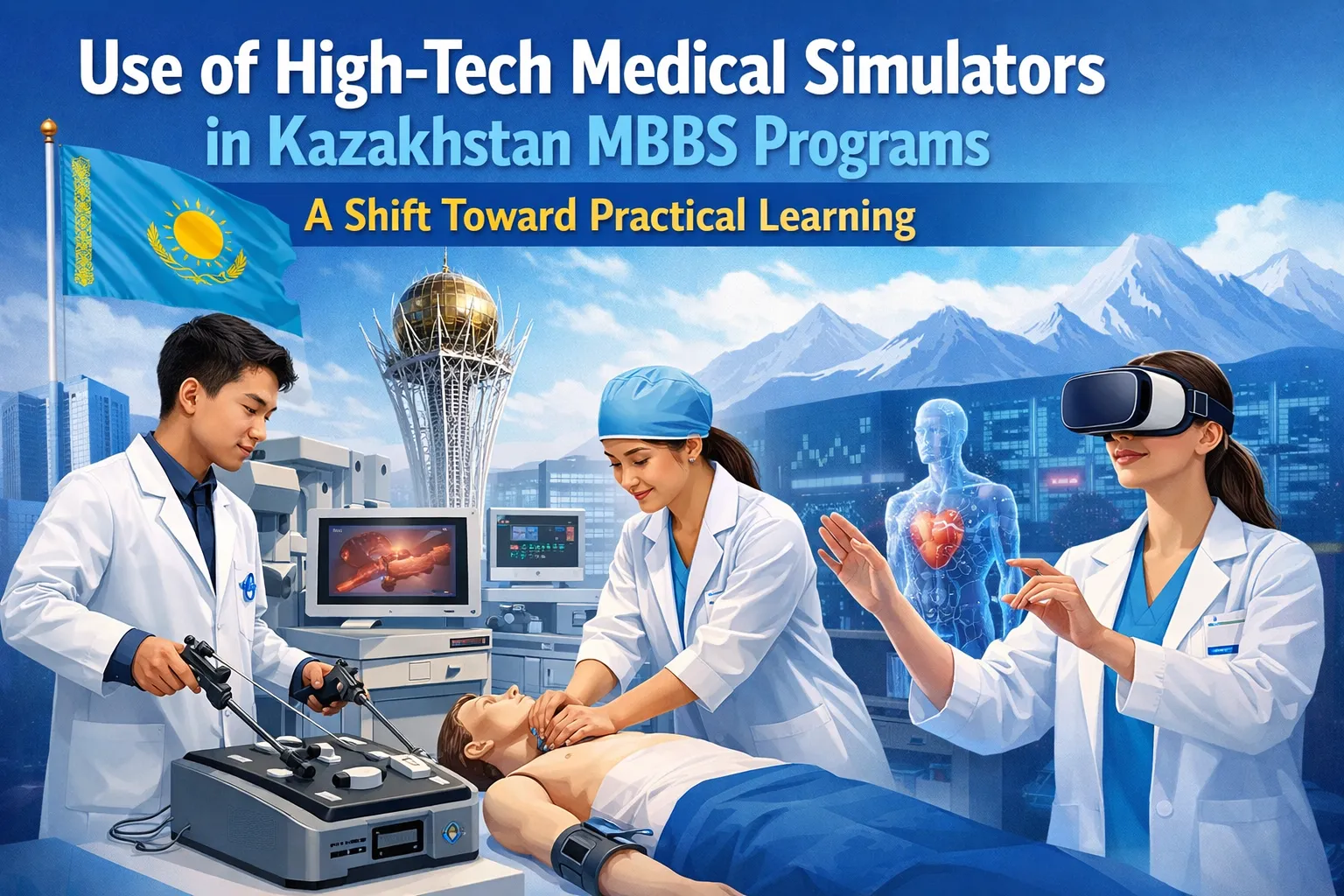
There is a massive change going on in medical education across the globe, and one of the most prominent ones is moving away from traditional theory-based teaching to practically-oriented learning. Kazakhstan has witnessed this global trend in the last few years and incorporated high-tech medical simulators into MBBS programs on its own.
This development is a great boon for the students of India who seek to pursue MBBS in Kazakhstan. This ensures that students not only learn the medical theory but also practice those theoretical concepts and skills in a real clinical environment, with the safety of being monitored and controlled.
The traditional gap in medical education
For decades, in many countries medical education relied heavily on textbooks and lectures. Although it was imperative that students had theoretical knowledge, they oftentimes graduated feeling unprepared to face real-world clinical scenarios.
Among the difficulties that many students encountered were:
- Less adjacently exposure to the patient population in earlier years
- Lack of hands-on practice
- Be afraid to makeble mistakes during real procedures
The gap between theory and practice has troubled global medical education for some time — and now Kazakhstan is doing something about it.
What Are High-Tech Medical Simulators?
Medical simulators are high-tech training devices that model real-life conditions.
These include:
- Mannequins that mimic human body functions (heartbeat, breathing, bleeding)
- Immersive VR systems for surgical educational training
- Computer-based diagnostic simulations
- Interactive patient-care scenarios
These simulators give students hands-on experience practicing procedures ranging from injections to surgeries to emergency responses and diagnosis — all without jeopardizing the lives of patients.
Kazakhstan's Adoption of Simulation-Based Learning
Kazakhstan's medical universities are building simulation labs, investing in the latest technology — attempting to meet global standards for education.
Several factors are driving this transition:
Global Medical Education Standards
Kazakhstan MBBS colleges facilitate international branches according to global standards. Institute listed on the World Directory of Medical Schools (WDOMS) are maintaining quality training standards.
Simulation-based learning drives universities to upgrade to meet these expectations through a structured approach with practical training modules.
Focus on Patient Safety
Perhaps the biggest advantage of simulators is that students can make mistakes — and learn from those mistakes — without hurting real patients.
It fosters confidence and provides the students to be better trained before entering real clinics.
Alignment with Healthcare Guidelines
Being up to date by working until October 2023 These are based on global frameworks recommended by the WHO and promote simulation-based training for medical students at many universities in Kazakhstan.
Simulation Labs: Revolutionizing MBBS Programs
Simulation laboratories are now becoming a core component of medical universities in Kazakhstan.
These labs simulate hospital settings in which students can practice:
- Emergency response (CPR, trauma care)
- Surgical procedures
- Patient diagnosis and treatment planning
- Communication skills with patients
Students are exposed earlier to practical training instead of having to wait until clinical years.
Benefits for Indian Students
High tech simulators will be integrated, which have benefits for Indian students up for studying abroad.
Early Clinical Exposure
Students don’t need to wait until a later year to get hands-on experience. They learn with real-world cases right from the start.
Increased Confidence
Having had ample opportunity to practice in a low-risk setting, students can build confidence in their abilities. By the time they land in hospitals, they have already been through with procedures.
Better Exam Preparation
Simulation-based learning prepares students for both clinical examinations and licensure exams. This aspect is especially crucial when preparing for NMC-regulated examinations among Indian students.
Improved Career Opportunities
Thus, graduates who have quality practical work skills are more competitive in the global labor market. Law students gain an edge in their practice in India or abroad by simulation training.
Real-World Applications of Simulation Training
Simulation training is not merely learning techniques — it gets students ready for real life challenges.
Some examples include:
- Managing emergencies like heart attack
- Performing surgical procedures step-by-step
- Diagnosing complex medical conditions
- Managing patient communication and decision-making
Such experiences mesh classroom education with real hospital practice.
Challenges and Limitations
Although simulation-based learning is extremely valuable, it does not come without its challenges.
High Cost of Technology
Establishing simulation labs needs a huge investment. And not all universities have access to the latest equipment.
Limited Replacement for Real Patients
While simulators can recreate lots of situations, real human interaction cannot be replaced. Clinical exposure in the hospital is still vital.
Need for Skilled Trainers
Students often need guidance to navigate these scenarios, and universities require trained faculty to be effective simulators.
Medical Education in Kazakhstan: Its Future
The use of high-tech simulators is only the start. Kazakhstan moves towards the development of progressive, innovative education.
In the future, we can expect:
- Increased use of virtual reality (VR) and artificial intelligence (AI)
- Less traditional and rigid forms of education
- Expanding cooperation with international medical institutions
- Expansion of simulation-based assessments
This transformation has enhanced the appeal of MBBS in Kazakhstan, particularly for students seeking practical and contemporary medical education.
This Matters for Future Doctors
And medical education is not only about passing exams — it’s about saving lives. For every doctor, the skill of responding rapidly, deciding and performing a procedure precisely is the key.
Simulation-based learning ensures that students:
- BLUM:/ Learn through doing, not memorizing
- Develop critical thinking skills
- Gain confidence in real-world situations
With this approach, they become the doctors best prepared for the realities of today's health care.
Final Thoughts
This paradigm shift demonstrates that Kazakhstan is adapting to this modern medical education philosophy where high-tech medical simulators are an integral part of MBBS programs. This allows Indian students to benefit from a modern education system that establishes a balance between practical experience and theoretical knowledge.
Kazakhstan is joining the ranks of countries offering world-class medical education, combining quality with worry-free affordability – a key consideration as global medical education continues to innovate.
For students who look to study MBBS in Kazakhstan, this impetus towards a simulation-based training system is a strong indication that the country is not only keeping pace with global standards — it is forging ahead.