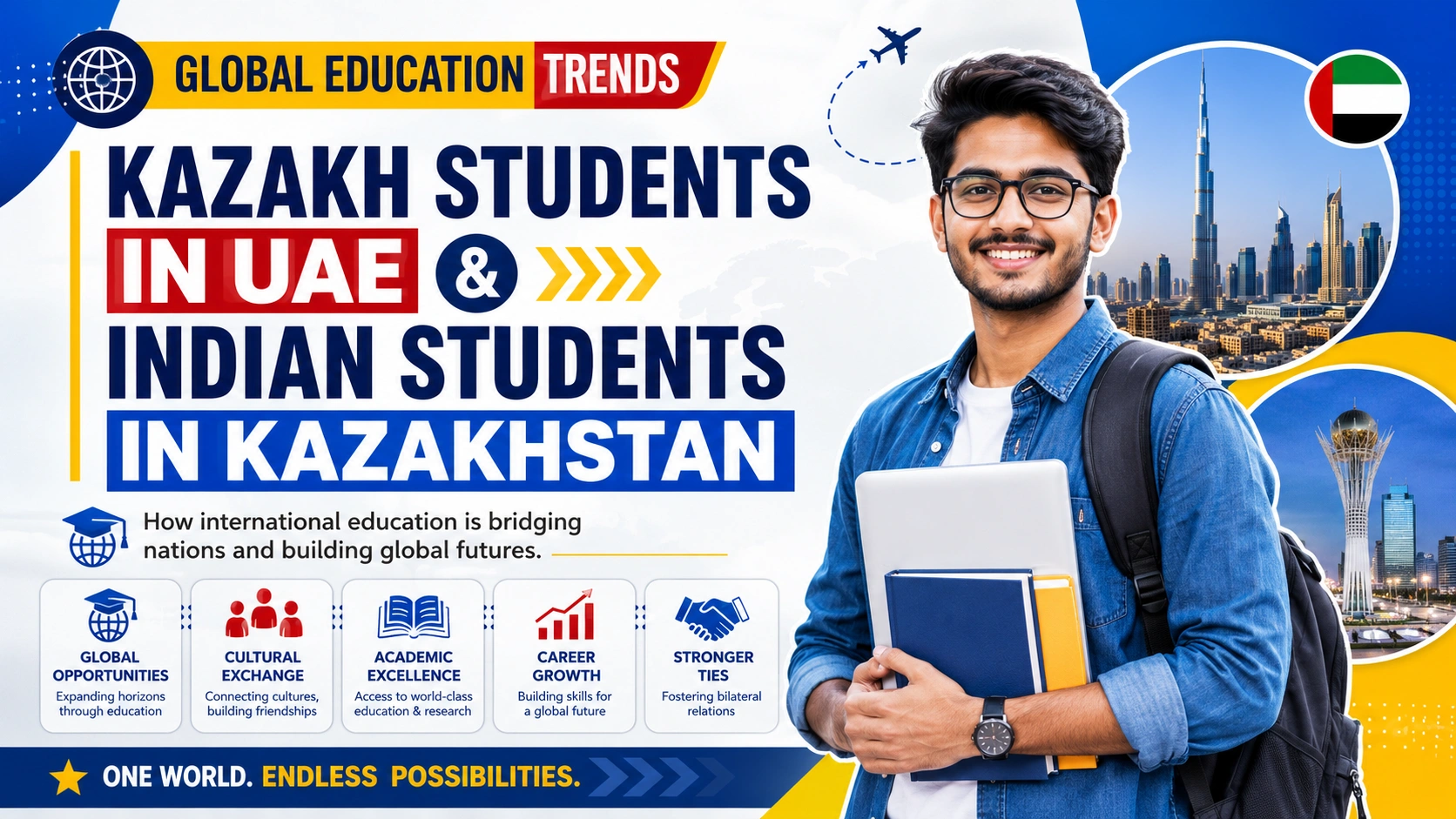
Student mobility has quietly become one of the most revealing indicators of how global education is shifting. Two patterns, in particular, stand out when you look at Central Asia and the Gulf together: a growing number of Kazakh students choosing the UAE for higher education, and an even larger, longer-running wave of Indian students choosing Kazakhstan for medical education. At first glance these look like unrelated stories. Looked at together, they tell us something bigger about where global education is heading — and why countries like Kazakhstan have become serious players in this shift.
A Two-Way Flow Reshaping Regional Education
For decades, "study abroad" for students in this part of the world meant the US, UK, or Australia. That's still true for a large share of students, but the picture has diversified. Kazakhstan alone now sends more than 90,000 students abroad every year, and while the US, UK, and Russia remain the traditional favorites, the UAE has emerged as a fast-growing regional hub pulling in students from across Central Asia and South Asia.
At the same time, the UAE's own higher education sector has been on a tear. The country's Ministry of Higher Education and Scientific Research recorded 57,035 new student admissions in the 2024–25 academic year — a 13% jump and the highest intake in a decade — with international enrollment in Dubai's private universities rising 29% and now making up 35% of the total student body. Dubai's education regulator has openly set a target of reaching a 50% international student share by 2033.
Meanwhile, in the opposite direction, India continues to send tens of thousands of medical aspirants to Kazakhstan every single year — a flow that has been building steadily for over a decade and shows no sign of slowing down for MBBS in Kazakhstan 2026 admissions.
Two very different motivations, two very different destinations, but one shared theme: students are increasingly willing to cross borders when their home country's higher education system can't keep pace with demand.
Why Kazakh Students Are Looking at the UAE
Kazakhstan has built a genuinely strong domestic higher education system — public spending on education has steadily increased, and government-backed programs like the Bolashak International Scholarship have sent thousands of students abroad for postgraduate study since the 1990s. But outbound mobility from Kazakhstan isn't only about the traditional Bolashak destinations of the UK, US, and Russia anymore.
The UAE offers something that appeals directly to ambitious students from Central Asia: proximity, a tax-free professional environment after graduation, rapidly rising university rankings, and an increasingly international, English-medium academic culture. The UAE climbed several places in 2025 in the QS World University Rankings by Subject, with nearly half of its ranked university programs improving year-on-year. For a Kazakh student weighing options, that combination of academic credibility plus regional convenience is hard to ignore.
It also helps that the UAE has been actively building its international reputation as an education hub — investing heavily in infrastructure, expanding visa flexibility for students, and opening new international university campuses. Four new international universities opened in Dubai alone in the 2024–25 academic year. None of this is exclusive to Kazakh students, but it's part of why students from across Central Asia, South Asia, and the wider Gulf periphery are increasingly putting the UAE on their shortlist alongside the US and UK.
Why Indian Students Are Looking at Kazakhstan
If the UAE's appeal to Kazakh and other regional students is about prestige and economic opportunity, the appeal of Kazakhstan to Indian students is rooted in something far more practical: access.
India produces well over a million NEET aspirants every year, but the number of MBBS seats — particularly affordable government seats — falls drastically short of demand. Private medical colleges in India routinely charge ₹50–80 lakhs for a full course, often with capitation fees on top. Against that backdrop, MBBS in Kazakhstan for Indian students has become one of the most practical alternatives available, for a few clear reasons:
- Affordability: The full six-year course, including hostel and living costs, typically falls between ₹18–35 lakhs — roughly half of what a private Indian medical college charges.
- No donations or capitation fees: Admission is based on academic eligibility and a qualifying NEET score, not on how much a family can pay upfront.
- English-medium instruction: Most universities offering study MBBS in Kazakhstan programs teach entirely in English for international students, without requiring IELTS or TOEFL.
- Recognized degrees: A significant number of Kazakh medical universities are listed with India's National Medical Commission (NMC), recognized by the World Health Organization (WHO), and listed in the World Directory of Medical Schools (WDOMS) — the global registry that verifies a medical school's legitimacy worldwide.
This combination of cost, access, and recognized credentials explains why thousands of Indian students continue to choose MBBS in Kazakhstan every admission cycle, even as other destinations open up.
The Common Thread: Capacity Gaps Drive Global Mobility
Step back, and both trends are really answers to the same underlying question: what happens when a country's own higher education system can't absorb its students' ambitions?
- India has the demand (NEET registrations routinely cross 2 million candidates a year) but not nearly enough affordable medical seats to match it.
- Kazakhstan has built strong domestic capacity in many fields but still sees students looking abroad for global brand-name universities, English-language postgraduate options, and career environments tied to international economies.
- The UAE has positioned itself precisely to absorb that overflow demand — not just from the Gulf, but from across the wider region — by building world-class infrastructure faster than most countries can.
What ties all three together is that none of this mobility is random. Students and families are making calculated decisions based on cost, recognition, and long-term career value — and governments and universities on the receiving end are actively competing for that demand.
Recognition Matters More Than Geography
One pattern that holds true across both trends: credential recognition is the deciding factor, not just geography or prestige.
For Indian students evaluating MBBS in Kazakhstan 2026 options, the non-negotiable checklist is the same every year — confirm the university appears on the NMC's list of recognized foreign medical institutions, confirm it's listed in WDOMS, and confirm graduates are eligible to sit the FMGE or the upcoming NExT licensing exam to practice in India. Without that recognition, even the most affordable degree has limited practical value back home.
The same logic applies to Kazakh and other regional students evaluating UAE universities — accreditation, international ranking, and whether a degree is recognized for licensing or employment purposes back home (or for further study elsewhere) matters far more than which city the campus is in.
This is really the quiet rule underneath all global education mobility trends: students aren't just chasing a country, they're chasing a credential that will hold up wherever they end up working.
What This Means for the Next Few Years
A few trends look set to continue and even accelerate:
- The UAE's pull on regional students will keep growing. With Dubai targeting 50% international enrollment by 2033 and continued investment in new international campuses, more students from Central Asia, South Asia, and beyond are likely to add UAE universities to their shortlists.
- India's outbound medical education flow isn't slowing down. Until India significantly expands affordable MBBS capacity at home, MBBS in Kazakhstan for Indian students will remain one of the most accessible and cost-effective pathways into medicine for middle-class families.
- Recognition bodies will matter more, not less. As more countries open their doors to international students, scrutiny around NMC approval, WHO recognition, and WDOMS listing will only increase — both from regulators and from families doing their own due diligence before committing six years and a six-figure-dollar investment to a degree.
- Central Asia and South Asia will keep showing up on each other's radar. Whether it's a Kazakh student weighing Dubai against London, or an Indian student weighing Almaty against an expensive private seat back home, the broader trend is the same: students are no longer limited to the traditional handful of English-speaking destinations. The map of "study abroad" has genuinely widened.
Conclusion
The stories of Kazakh students heading to the UAE and Indian students heading to Kazakhstan might look like two separate footnotes in global education data — but together, they capture exactly how today's students make decisions: by weighing cost against credibility, and access against long-term recognition.
For Indian families specifically, the practical takeaway hasn't changed even as the broader picture has gotten more complex. If the goal is a globally recognized, NMC-approved medical degree without the financial burden of an Indian private college, study MBBS in Kazakhstan remains one of the most reliable and well-established routes available — and for students applying for MBBS in Kazakhstan 2026 intake, the fundamentals that have made this destination popular for over a decade are still firmly in place: affordable fees, English-medium teaching, no donations, and a clear path back to practicing in India after clearing the FMGE or NExT exam.