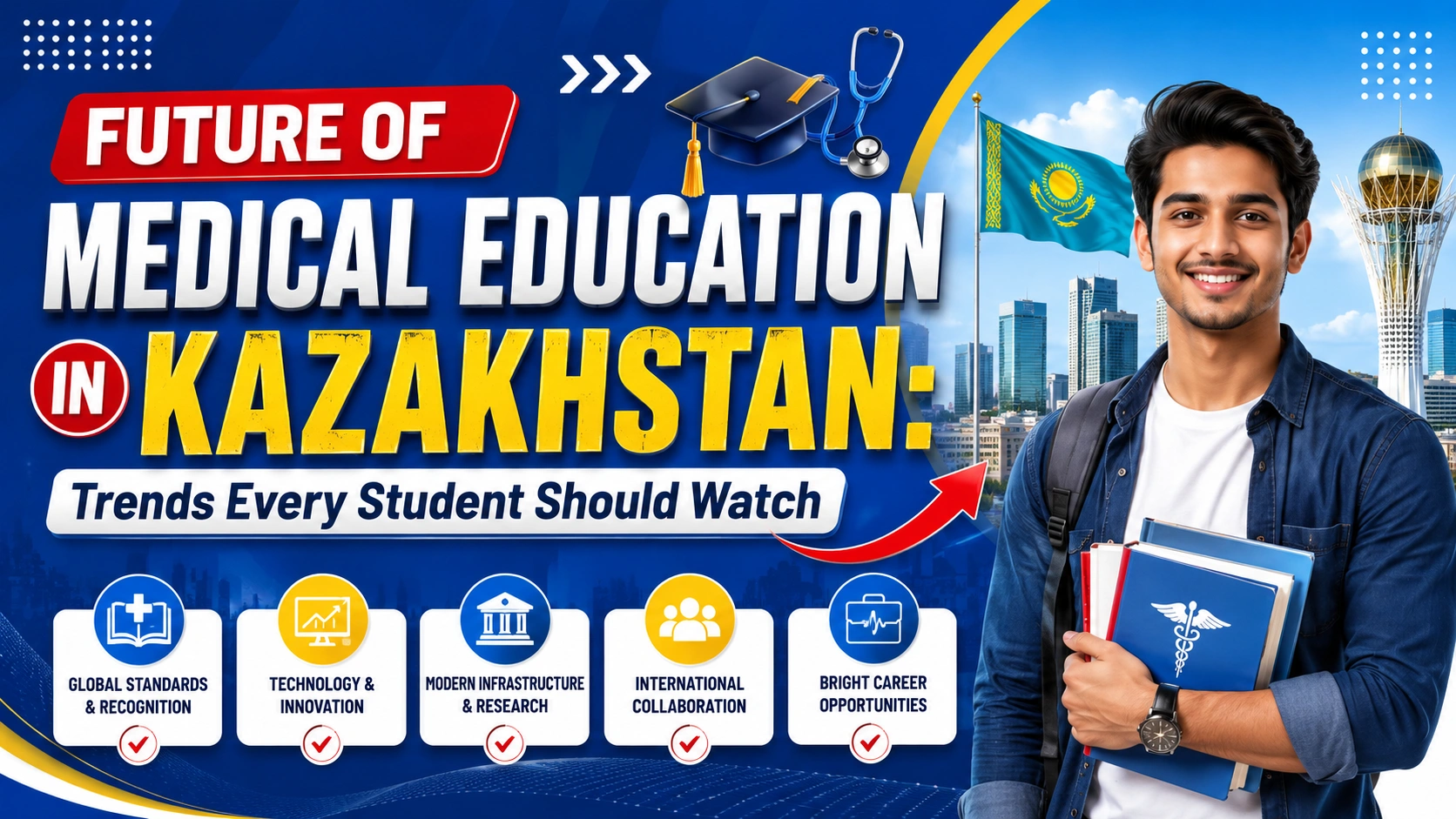
Here's something every Kazakhstani medical student should know: the state of medical education in Kazakhstan is evolving. There's no denying that our digital infrastructure is improving; curriculum reforms are being implemented; Kazakhstan is positioning itself as a medical education center for Central Asia; and the FMGE is being replaced with NExT. A student enrolling in a Kazakhstani medical school in 2026 will have a radically different experience than a student who graduated 6 years prior.
If you are a prospective medical student in Kazakhstan, you are going to want to know about all of these new advancements. It is going to influence the medical school you attend, the preparation you do, and the way you approach your licensing. Here are the changes and why they matter.
1. Medical Curriculum Focus is Changing due to FMGE - NExT Transition
As far as changes in medical education abroad are concerned, nothing in the last 10 years has been more impactful for the Indian student than the transition from the Foreign Medical Graduates Examination (FMGE) to the National Exit Test (NExT). The transition is not limited to Kazakhstan and Indian students, but rather graduates from all the foreign medical universities. Responsive to the changing landscape, Kazakh medical universities have begun adapting.
For years, preparation for the FMGE has been the responsibility of the medical student. With the transition to NExT, several leading medical universities of Kazakhstan have begun the process of integrating FMGE and NExT preparatory coaching into the curriculum in the 3rd year of the program.
As opposed to a 6 year academic exercise, medical students will now be trained and educated in clinical and case-based methodologies that are relevant to the licensing examination throughout the curriculum.
2. Simulation Labs and Digital Classrooms Are Becoming the Norm
Modern medical labs have changed significantly since a dissection hall was the definition of a "modern lab". Medical Universities in Kazakhstan are putting substantial funds towards the construction of Simulation Centers, smart classrooms, digital libraries, and other infrastructures that allow the students to make and learn from mistakes about clinical decisions before encountering the real world of clinical medicine.
An example of this is the ASPIRE-to-Excellence award presented to Karaganda State Medical University for their advancement in the development and enactment of Simulation Based Education. This award helps exemplify the movement in the region towards the development and implementation of Problem Based Learning and away from the traditional methods based on rote memorization. Medical universities in the region are developing and implementing technology in the practice of medicine, and are researching and developing the use of Artificial Intelligence in the field of medical diagnostics. This movement is being discussed and promulgated in the medical education forums of the region during the year 2026.
3. Universities Are Expanding International Partnerships and Credit Mobility
Kazakhstan's medical universities have been steadily building partnerships through programs like Erasmus+ and Tempus, enabling credit mobility, joint research, and faculty exchange with European institutions. This isn't just about optics — it reflects a genuine push toward aligning Kazakh medical education with broader international standards, which strengthens the long-term credibility of degrees earned there.
This internationalisation push is also part of why Kazakhstan has positioned itself with ambitions to become a leading medical education destination in Central Asia, competing not just on cost but increasingly on academic quality and global recognition.
4. More Recognition = More Validation, and Students Win
With Indian students increasingly going abroad for studies, there is more focus on the "hidden fees" phenomenon and degrees with dubious or no recognition. Universities with artificially low fees (usually only the fees for the first year) or direct student contact (bypassing sanctioned representation) are increasingly being identified as suspect by educational consultants in the Kazakhstan MBBS space in 2026.
This concern is valid and will further student interests by better differentiating universities that are internationally recognized and those that are not.
The standard (or bottom) differentiators for recognized universities are still the same:
- Check that the medical school is in the World Directory of Medical Schools (WDOMS).
- Check that the school's medical program is in line with the World Health Organization (WHO) International Standard and that they are in compliance with the National Medical Commission (NMC) of India to ascertain eligibility for the FMGE/NExT examination.
- Check that you have a valid NEET score for admission since it is mandatory for students wishing to pursue an MBBS degree, whether in India or abroad.
In a growing market, the importance of the following four checks increases rather than declines.
5. 'MD' And 'MBBS' Terminology Finally Starting To Make Sense
One development easing the pressure for applicants hoping to get in in 2026 concerns terminology. In Kazakhstan, Russia, and many of the former Soviet Union republics, the primary medical qualification is called an 'MD' (Doctor of Medicine), not 'MBBS'. It's the same 6-year program of primary medical education that is offered in many countries of the world. It's terminology. It's not a program or a recognition issue.
As more Indian students and consultants learn of this, expect universities to adjust their communication, and less confusion for families comparing an 'MBBS' against a Kazakh University 'MD' listing.
6. Increasing Number of Indian Students Equals Improved Infrastructure
As more than 9,500 Indian students are reported to be studying in Kazakhstan, Universities are building systems to accommodate them, such as dedicated offices for international students, buddy systems, upgraded Indian dining facilities, and improved liaison with the Indian Embassy in Astana for visa and welfare.
As more students use Study MBBS in Kazakhstan, this will improve the network for students. For incoming students, this means less of the "figuring it out alone" experience that the early cohorts faced.
7. NEET Validity and Multi-Year Planning Are More Flexible Now
Another important change to note is that NEET scores remain valid for multiple years for students intending to study abroad. This allows families to plan study abroad opportunities more strategically and reduces the need to view study abroad as an expensive, one-time opportunity to be decided on in a very short time frame. For example, a student planning to apply in 2026 can choose the time when they are ready and able to finance their trip to Kazakhstan without any pressure from the very short time frame that occurs after the NEET exam.
8. Reform in Ophthalmology Residency and Specialties Shows a Quality Improvement Trend
Kazakhstan is also reforming the postgraduate and residency extensions beyond the MBBS/MD. For example, a new three-year residency program modeled after existing formal programs in other countries will replace previous short, incomplete courses of residency training in Ophthalmology. This indicates a postgraduate reform shift in the context of medical education. As such, it is a good decursing sign, showing that all other training, beyond the preliminary training, will be modeled and viewed internationally and integrated with other formal, structured postgraduate programs.
9. Friendly Competition in Central Asia Is a Good Thing
Kazakhstan is not the only country that is pursuing Indian medical students. Other countries, such as Kyrgyzstan and Uzbekistan, are doing the same. While it has become a more international marketplace, for medical students in Kazakhstan, this is a very good thing, as the educational institutions have more incentive to improve infrastructure, FMGE/NExT support, and international recognition beyond keeping tuition at a low level.
Meaning 2026 is a good year for a discerning applicant, the bar is being raised across reputable institutions, and universities understand families are doing their research now more than ever.
Prospects Based on the Above Trends
Accordingly, here are a few things to consider while finalizing your choice for MBBS in Kazakhstan 2026:
- Look for the universities that have integrated the NExT examination and subsequent licensing prep into their curricula.
- Ask specifically about the infrastructure for simulation and digital learning, as it is now a real differentiator between universities.
- Take the time to verify the university's recognition status (WDOMS, alignment WHO, NMC, etc.) as the university and or the agency's claims are likely to be incomplete, focusing on the universities on which scrutiny is being placed, because of "hidden fees".
- Don't be distracted by the "MD" vs. "MBBS" differentiation; it's terminology for the region and not the validity of the degree.
Consider the expanding Indian student support system a real positive and not simply a familiar factor, as both stronger peer support and university systems translate into a good six years.
Conclusion
For Indian students, the result will be more to consider, but will also provide further opportunities for reliable assessment. Kazakhstan's medical education system in 2026 has undergone significant positive transformation, compared to 2021, with regard to their digitalization, internationalization, focus on licensure exam and new standards for recognition.
When finalizing your shortlist for MBBS in Kazakhstan, it can be beneficial to speak with a counselor who can help you identify leading universities with NExT-integrated curricula and advanced simulation infrastructure, rather than just schools that offer the lowest fees.