The first week feels slightly unreal. A new country, an unfamiliar hostel room, documents in one folder, winter clothes in another, and parents calling every few hours to ask whether you’ve eaten. Then classes begin. Anatomy arrives, the excitement settles, and the real medical journey starts. For Indian students, MBBS in Kazakhstan is usually considered because tuition is more manageable than at many private medical colleges back home. But six years abroad cannot be judged by fees alone. Students must understand the course structure, language requirements, clinical training, Indian licensing rules, and the daily reality of studying thousands of kilometres away from home. Here is what the journey can look like—from admission to the final degree.
Before Departure: Admission and Eligibility Checks
What should happen before an application is submitted? Verification. Lots of it. Admissions at many Kazakhstan medical universities commonly begin several months before the autumn intake, with classes often starting around September or October. Dates differ between universities. Applying between April and August may provide enough time for document review, invitation processing, visa formalities, and travel arrangements, but students must confirm the current schedule directly.
Indian applicants generally need:
- A valid passport
- Class 10 and 12 certificates
- Physics, Chemistry, Biology, and English in Class 12
- The required PCB percentage under applicable regulations
- A qualifying NEET-UG result
- Passport-sized photographs
- Medical fitness and HIV reports, where required
- Translated, notarised, or apostilled documents, if requested
For eligible Indian students planning to practise in India, NEET qualification is required under the applicable rules. The qualifying marks change each year because the result is percentile-based. Check the current bulletin and result on the official NEET website. Don’t rely on a cutoff quoted from an older admission brochure.
University Selection: The Decision That Shapes All Six Years
A university offering the lowest tuition isn’t automatically the best choice. Simple. Students should compare the exact medical programme, not just the institution’s general reputation.
Before choosing MBBS in Kazakhstan, ask for the year-wise curriculum and written confirmation of:
- Total course duration
- Internship duration and location
- Medium of instruction
- Affiliated teaching hospitals
- Clinical rotation schedule
- Degree title awarded after graduation
- Eligibility for medical registration or licensing in Kazakhstan
- Hostel availability and annual charges
Check the institution in the World Directory of Medical Schools, but understand what that listing means. WDOMS is a directory; it doesn’t automatically confirm eligibility for registration in India. The exact programme must still meet the rules applicable to the student. Also, claims such as “WHO approved” are often loosely worded. The World Health Organization does not individually approve every foreign medical programme for Indian registration.
Understanding the Six-Year Course Structure
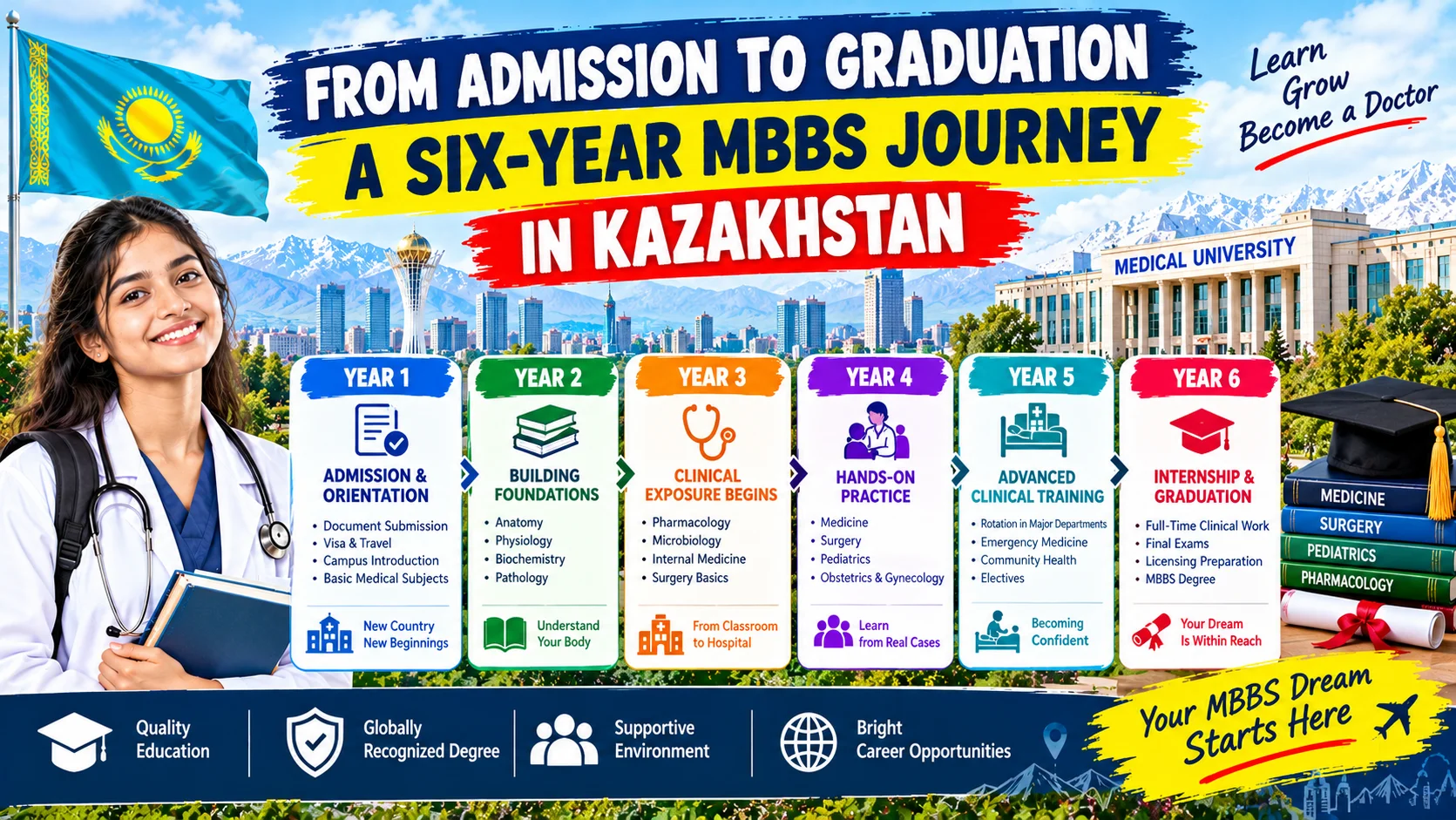
The medical programme is generally presented as six years, but how those years are arranged may vary between universities. Some institutions include clinical rotations and internship-style training within the complete duration. Others use a different academic sequence.
A typical progression may look like this:
|
Study Year |
Main Academic Focus |
|
Year 1 |
Anatomy, Physiology, Biochemistry, Histology |
|
Year 2 |
Pathology basics, Microbiology, Pharmacology foundations |
|
Year 3 |
Para-clinical subjects and introductory clinical exposure |
|
Year 4 |
Medicine, Surgery, Paediatrics, Obstetrics and Gynaecology |
|
Year 5 |
Advanced clinical rotations and speciality subjects |
|
Year 6 |
Internship, hospital rotations, assessments, and graduation requirements |
This is only a broad model. Students must obtain the official curriculum from their selected university because subject distribution and clinical schedules can differ.
Year One: Anatomy and a Completely New Routine
The first year is less about feeling like a doctor and more about learning how much there is to study. Anatomy alone can fill an entire week. Add Physiology, Biochemistry, Histology, and practical classes, and the timetable becomes serious quite quickly. Students also face everyday adjustments. They need to learn public transport, find affordable food, manage laundry, follow hostel rules, and cope with a much colder climate than most parts of India. In cities such as Astana and Karaganda, winter temperatures can fall far below zero. Proper winter clothing isn’t optional. Thermals, insulated footwear, gloves, and a suitable jacket may cost approximately ₹25,000–₹60,000 during the initial setup, depending on quality and where items are purchased. The academic lesson from year one is straightforward: don’t study only before semester examinations. Review daily. Even 60–90 focused minutes after class can prevent an unpleasant rush later.
Year Two: Building Strong Medical Foundations
By the second year, Kazakhstan feels less unfamiliar. Students know the city better, understand their teachers’ expectations, and have probably discovered which hostel meal they absolutely cannot eat again. Academically, concepts begin connecting. Pathology explains how disease changes organs and tissues. Pharmacology introduces drug actions and adverse effects. Microbiology identifies the organisms behind infection. The exact sequence may vary, but the workload usually becomes heavier. This is a good time to begin light preparation for Indian licensing examinations. Nothing extreme. Twenty to thirty MCQs on completed subjects, a small error notebook, and regular revision are enough initially. Students pursuing MBBS in Kazakhstan should also start learning common Russian or Kazakh medical terms. Lectures may be conducted in English, yet local patients usually communicate in their own language. Waiting until clinical years to begin language learning makes hospital work harder than it needs to be.
Year Three: Moving from Theory to Clinical Thinking
Here comes the transition. Diseases are no longer just definitions; students begin understanding symptoms, investigations, diagnosis, and treatment as connected parts of one clinical problem. Third-year subjects may include Pathology, Pharmacology, Microbiology, Forensic Medicine, Community Medicine, diagnostic methods, and early clinical disciplines, depending on the university. Practical assessments, oral examinations, and case-based discussions become more common. Honestly, this is where students discover whether they actually understood the first two years or simply memorised enough to pass. Weak Physiology affects Medicine. Weak Anatomy returns during Surgery. It all comes back.
A sensible routine at this stage includes:
- Revising university lectures on the same day
- Solving 30–50 subject-specific MCQs
- Connecting basic science with clinical cases
- Practising image-based questions
- Learning patient-history phrases in the local language
- Saving semester mark sheets and academic records
Not glamorous. Very effective.
Year Four: Hospital Training Becomes Serious
A white coat feels different inside an actual ward. Students may now rotate through Medicine, Surgery, Paediatrics, Obstetrics and Gynaecology, Psychiatry, Dermatology, ENT, Ophthalmology, or other departments. Clinical exposure differs between universities. Some institutions provide frequent bedside sessions and regular patient interaction. Others may rely more heavily on classroom teaching. That difference matters, particularly for international students who need supervision and help with local-language communication.
During hospital postings, students should practise:
- Taking a structured patient history
- Performing basic clinical examinations
- Presenting cases to faculty members
- Forming differential diagnoses
- Interpreting laboratory reports
- Reading common ECGs and X-rays
- Understanding initial treatment plans
Don’t remain a silent observer. Ask questions. Volunteer to present a case. The awkward first attempt is part of learning.
Year Five: Clinical Responsibility and Licensing Preparation
The fifth year usually feels more intense because final clinical subjects and future licensing plans begin competing for attention. University examinations matter, but Indian students must also prepare for the examination and registration pathway that will apply after graduation. The current requirements should always be checked through the National Medical Commission. NExT has been proposed as a common examination connected with licensing and postgraduate admission, while FMGE has traditionally remained the screening route for eligible foreign medical graduates. Implementation schedules and applicability can change through official notifications. Students shouldn’t stop studying while waiting for one final announcement. The medical syllabus remains the medical syllabus.
A practical fifth-year preparation plan could include:
- Completing one licensing-oriented revision of basic subjects
- Solving around 50–75 MCQs on most study days
- Practising clinical and image-based questions
- Reviewing Indian national health programmes
- Taking mixed-subject tests twice a month
- Maintaining concise notes for final revision
The goal isn’t to collect four coaching subscriptions. One primary learning source, one reliable question bank, and repeated revision are generally more useful.
Year Six: Internship, Rotations, and Final Assessments
The sixth year should bring the strongest clinical exposure, but students must verify how their particular university classifies this period. It may include internship training, advanced rotations, final examinations, state assessment, or a combination. Under the Indian rules applicable to certain foreign medical graduates, requirements may relate to the minimum duration of education, mandatory subjects, a supervised internship, clinical training in the foreign institution or country, and eligibility for local medical registration. The exact application can depend on the admission date and current regulation. This needs attention. Proper attention.
Before graduation, obtain clear records of every rotation, including:
- Department name
- Training dates
- Attendance
- Clinical activities
- Supervisor details
- Hospital name
- Assessment results
- Internship completion status
Students completing MBBS in Kazakhstan should not assume that missing foreign clinical requirements can automatically be completed after returning to India. Confirm everything in writing while still enrolled.
Fees and Living Costs Across Six Years
Tuition at several medical universities may range roughly from USD 3,500 to USD 6,500 per year, although some programmes can cost more. Hostel charges may fall around USD 600–1,500 annually, while food and daily living expenses can range from approximately USD 150 to USD 300 per month. A reasonable full-course budget might be around ₹25 lakh to ₹40 lakh or higher, depending on the university, city, exchange rate, travel frequency, and student lifestyle. This is a planning estimate. Families should obtain an official fee quotation and keep an additional 10–15% contingency fund.
Commonly missed expenses include:
- Annual insurance
- Visa or residence renewal
- Document translation
- University registration
- Laboratory or examination charges
- Local transport
- Winter clothing
- Medical equipment
- Flights to India
- FMGE or NExT preparation
- Degree authentication and apostille
Fees look manageable. Then the extras arrive.
Recognition and Document Safety
University recognition cannot be assessed through a single logo on a website. Students must verify the exact institution, campus, degree, study duration, internship, and local licensing position.
Keep physical and digital copies of:
- NEET admit card and scorecard
- Admission and invitation letters
- Passport and previous passports
- Visa and residence documents
- Entry and exit stamps
- Annual mark sheets
- Complete transcripts
- Clinical logbooks
- Internship records
- Degree certificate
- Medium-of-instruction certificate, if required
- Local licence or eligibility documentation
- Apostille and translated documents
Names and dates must match across every record. One spelling difference can create months of correspondence later.
Returning to India: FMGE or NExT
Graduation is a major milestone, but it doesn’t provide automatic permission to practise in India. Graduates must satisfy the licensing and registration rules applicable at the time of return. FMGE has traditionally included 300 multiple-choice questions, with a qualifying requirement of 150 marks out of 300, subject to the latest official bulletin. It has generally been conducted in two parts without negative marking.
A student who has prepared gradually during MBBS in Kazakhstan will usually find the post-graduation revision period more manageable. A possible six-month plan is:
- 10–12 weeks for complete first revision
- 6–8 weeks for second revision
- 3–4 weeks for rapid revision
- 15–20 full-length mock tests
- Daily review of incorrect and guessed questions
Don’t measure preparation only by study hours. Measure completed revisions, mock-test accuracy, and repeated mistakes.
Advantages and Challenges of the Journey
The experience can be rewarding, but it asks for maturity.
Possible Advantages
- Comparatively affordable tuition
- English-taught medical programmes
- International student community
- Exposure to another healthcare system
- Direct application options at several universities
- Lower entry cost than many Indian private colleges
Possible Challenges
- Severe winters
- Russian or Kazakh needed for patient communication
- Clinical exposure varies by institution
- Currency fluctuations affect the family budget
- Long periods away from home
- Separate Indian licensing preparation
- Differences in food and teaching style
Students who adapt early usually cope better. Those expecting the university to manage every personal and academic problem may find the transition rough.
FAQs
Is the medical course in Kazakhstan exactly six years?
Many international medical programmes are presented as six-year courses, but their academic, clinical, and internship structure may differ. Check the official curriculum before accepting admission.
Is NEET compulsory for Indian students?
Indian students covered by applicable regulations must qualify NEET before joining a foreign medical programme if they intend to pursue medical registration in India.
What is the approximate total cost?
A broad six-year budget may range from ₹25 lakh to ₹40 lakh or more. Tuition, hostel, food, flights, insurance, visa expenses, and currency movement all affect the total.
Are all lectures conducted in English?
Many international programmes advertise English-medium teaching. Still, Russian or Kazakh may be necessary during clinical postings because patients and hospital staff commonly use local languages.
Can a graduate practise directly in India?
No. A foreign medical graduate must meet the applicable NMC eligibility, examination, internship, and registration requirements before practising independently in India.
When should licensing-exam preparation begin?
Light preparation can begin during the first two years. Structured revision should become more serious from the fourth or fifth year, well before graduation.
Conclusion
The journey begins with an offer letter, but it is shaped by thousands of ordinary days—morning lectures, crowded practical rooms, difficult oral examinations, winter commutes, patient histories, and late-night revision. Choosing the right university is only the first decision. Staying disciplined is the bigger one. Students considering MBBS in Kazakhstan should verify the programme carefully, use every clinical opportunity, preserve their documents, and prepare for Indian licensing requirements throughout the course. Six years pass faster than expected. Better to make each one count.