Pursuing MBBS in Kazakhstan opens doors for thousands of Indian NEET aspirants each year, but the real test comes later: cracking the FMGE (Foreign Medical Graduate Examination) or the upcoming NExT. You've invested six years abroad, dreaming of practicing medicine back home—only to hear horror stories about low pass rates and endless prep. Is it all hype, or a genuine hurdle? This post dives deep into the pass rates, smart preparation strategies, and an honest reality check to help you decide if this path aligns with your goals.
Picture this: You're back in India after your MBBS, stethoscope in hand, but without FMGE clearance from the National Medical Commission (NMC), you can't treat a single patient. Kazakhstan grads face the same screening as all foreign medical graduates, ensuring your degree from a World Directory of Medical Schools (WDOMS) listed university meets global standards. But success isn't automatic. Let's unpack the numbers, tips, and truths step by step.
Understanding FMGE and NExT Basics
FMGE is your gateway to practicing in India after a foreign MBBS. It's a 300-question MCQ exam held twice yearly by the NMC, covering all 19 MBBS subjects like anatomy, pharmacology, and surgery. Pass it, and you get provisional registration for internship; clear both attempts if needed.
NExT (National Exit Test) looms on the horizon, replacing FMGE soon. It combines licensing with PG entrance, making it tougher but fairer. For now, focus on FMGE patterns, as NExT builds on them. Kazakhstan's English-medium curriculum aligns well, but clinical exposure gaps can trip you up.
No shortcuts—eligibility requires a primary medical qualification from an NMC-approved uni, plus a one-year internship completion. Prep starts in Kazakhstan, not post-graduation.
FMGE Pass Rates for Kazakhstan Graduates
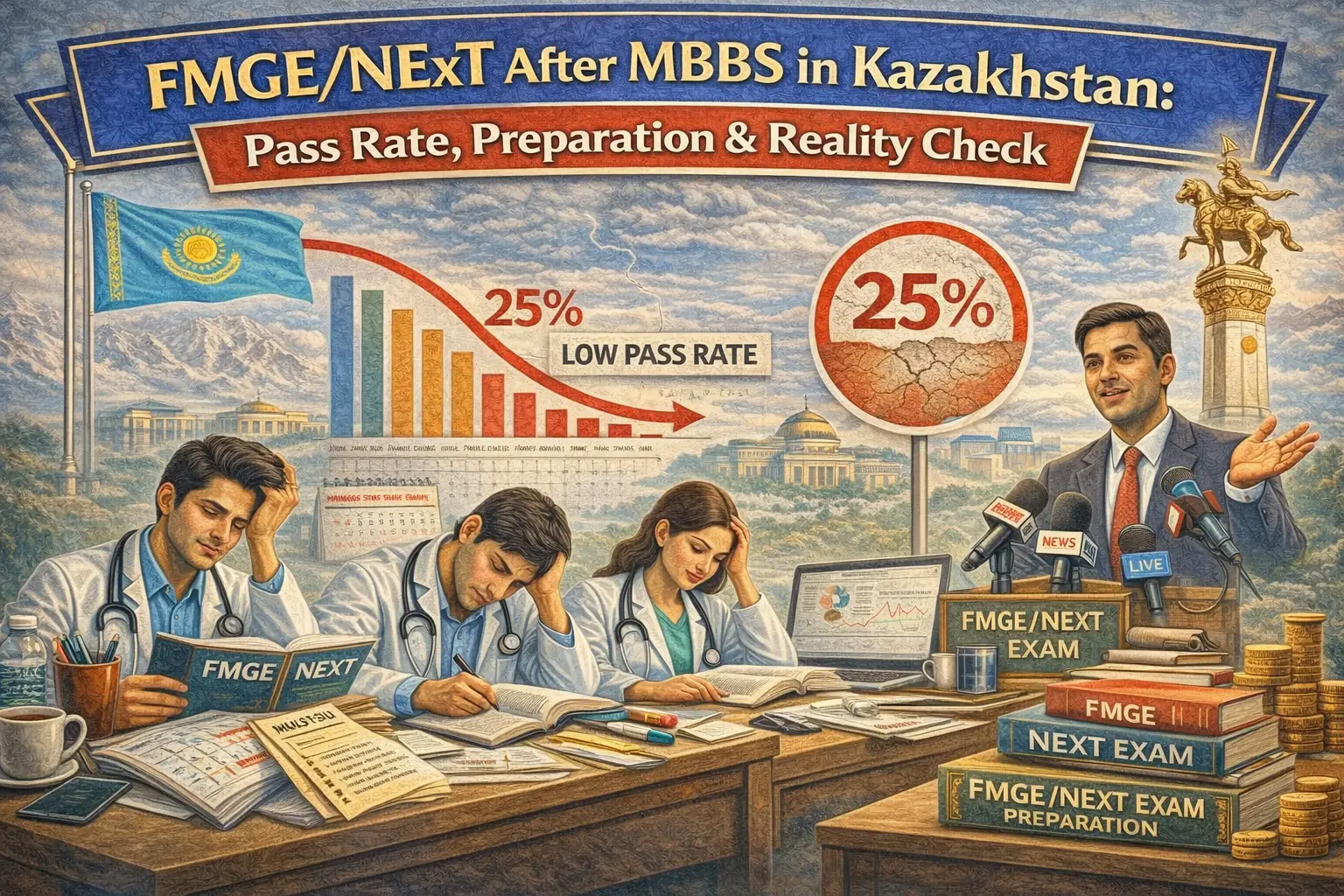
Pass rates spark endless debates. Overall FMGE average hovers around 20-25%, and Kazakhstan holds steady at 15-25% historically, comparable to Russia or Kyrgyzstan but trailing Bangladesh (30-40%). Recent data shows top unis like Kazakh National Medical University hitting 25-30% in 2024 sessions.
Why the variance? University choice matters hugely. Semey State Medical Academy boasts 15-20%, while weaker ones dip below 10%. Total Kazakh grads attempting FMGE: over 14,000 in recent years, with about 2,400 passing—17% overall. It's not dismal, but not a breeze either.
Compare globally: Nepal leads at 30%, Philippines 24%. Kazakhstan shines for affordability, but demands discipline. Good news? Rates are climbing with better prep resources and aligned syllabi.
Factors Affecting Pass Rates from Kazakhstan
Kazakhstan's strengths help: English instruction matches FMGE, and WHO-approved unis ensure quality basics. But challenges exist. Clinical rotations start late (year 4-5), so hands-on practice lags behind Indian grads. Language in hospitals (some Russian) hones skills differently.
Student habits play in too. Those ignoring FMGE from year one struggle. Top performers treat Kazakhstan like "MBBS phase 1," prepping parallel. Data shows 2023-24 saw upticks—27% at some unis—thanks to Indian faculty hires and apps like Marrow.
Pick unis with strong FMGE track records via MBBS in Kazakhstan. Avoid fly-by-night options.
Preparation Strategies That Work
Start early—that's rule one. From semester one in Kazakhstan, dedicate 2 hours daily to FMGE apps. Anatomy and physiology build foundations; neglect them, and surgery crumbles later.
Join online platforms: PrepLaddar, Marrow, or DAMS offer 80% image-based questions mirroring FMGE. Solve 50 MCQs daily, revise notes weekly. Focus 40% pre-clinical, 60% clinical subjects—medicine, surgery dominate.
Mock tests are gold. Take 10 full-length ones monthly in year 5-6. Analyze errors: Was it concept gap or silly mistake? Group studies with Indian batchmates recreate exam pressure.
Back home, 6-month crash courses in Delhi or Kota boost weak areas. Books? Harrison for medicine, Bailey for surgery—stick to Indian authors for FMGE twist.
NExT prep? Same base, plus deeper reasoning. Kazakhstan grads adapting early will lead.
Daily Study Plan for Kazakh MBBS Students
Year 1-2: Basics only. 1 hour Marrow videos post-class. Anatomy dissections? Link to FMGE images.
Year 3-4: Ramp up. 3 hours daily—2 theory, 1 MCQs. Clinical subjects via YouTube (Dr. Bhatia).
Year 5-6: Full throttle. 6 hours: 3 revision, 2 mocks, 1 weak topics. Weekend marathons.
Post-grad: 8-10 hours intensive. No distractions—hostel life suits this.
Track progress: 40% mocks by attempt one? Safe bet.
Common Pitfalls and How to Dodge Them
Procrastination kills. "I'll prep after MBBS" fails 70% first time. Syllabus mismatch? Kazakhstan skips some India-specific topics—patch via apps.
Burnout from cold Almaty winters? Schedule breaks, Indian food runs. Poor uni choice tanks odds—verify NMC lists religiously.Ignore internship? FMGE mandates it. Fake docs? Jail risk. Honesty pays.
Success Stories from Kazakhstan Grads
Meet Ravi from UP: Semey grad, 18% batch pass, but he cracked FMGE first try via daily Marrow. Now rural GP, earning 1 lakh/month.
Priya, Kazakh National: 27% pass year, post-grad MCI trainer. "Parallel prep was key—uni gave basics, I built FMGE muscle."
These aren't outliers. WhatsApp groups overflow with tips; join verified ones.
NExT: What's Changing and Why It Helps
NExT unifies exit, licensing, PG. Tougher skills test, but Kazakhstan's practical focus aligns. Early buzz: pass rates may rise with standardized prep. Start FMGE now—it's NExT foundation.
Cost of Preparation
Apps: 10-20k/year. Crash course: 50k. Total under 1 lakh—peanuts vs. MBBS fees. ROI? Lifelong doctor salary.
Reality Check: Is It Worth It?
Yes, if committed. 20% pass means 1 in 5 succeeds—better odds than lotteries. Fail twice? Retry or PG abroad. But most who prep smart pass.
Kazakhstan saves 40-50 lakhs vs. India privates. FMGE hurdle weeds out unserious—survivors thrive.
Your Action Plan
Verify uni on WDOMS. Enroll via MBBS in Kazakhstan.Day 1 abroad: Download Marrow. Monthly mocks. Year 6: Full focus.Back home: 6 months grind. Pass, intern, conquer.
Conclusion
FMGE/NExT after MBBS in Kazakhstan isn't luck—it's prep meets opportunity. Rates are solid (15-30%), stories inspire, strategies proven. Ditch doubts, embrace discipline. Your white coat awaits—will you claim it? Drop questions below; let's chat.