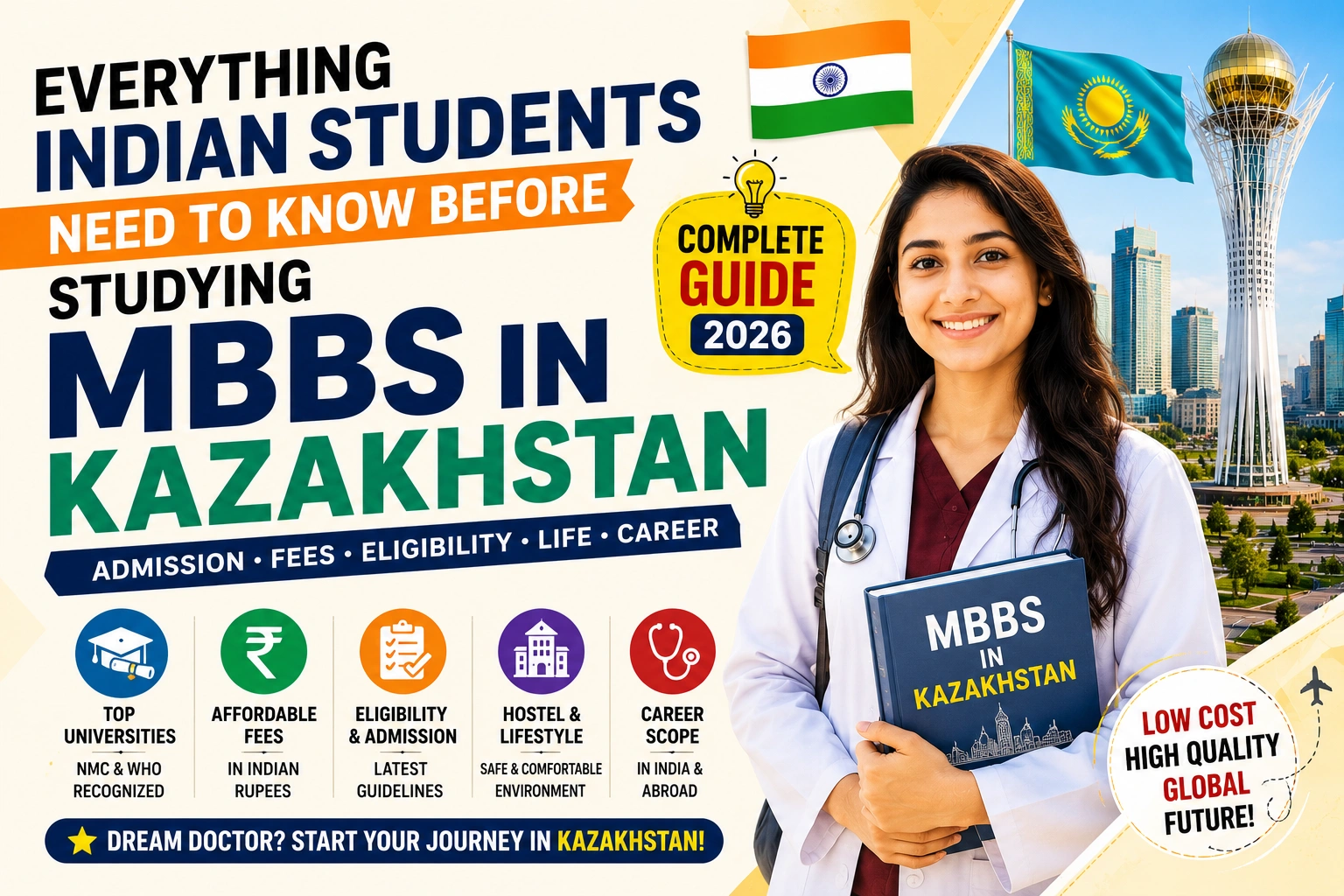
Studying MBBS overseas can be a good alternative for Indian students who want to become doctors, but cannot secure a government seat. MBBS in Kazakhstan is one of the fastest-growing destinations because it offers a variety of clinical experiences, affordable tuition fees and established medical schools. Kazakhstan, the ninth largest country in the globe, has a developed higher education sector that includes medical education. Many universities in Kazakhstan have medical faculties that are well-established and offer training via affiliated hospitals and clinics. The choice of a foreign medical school should not be solely based on the low tuition fees. Students from India should carefully review the university's accreditation status, the course structure, the clinical training, the eligibility requirements, and the compliance with rules for Foreign Medical Graduates working in India. Students can find out more about the universities, admissions procedures, fees, and other aspects related to studying medicine in Kazakhstan by visiting MBBS In Kazakhstan.
Why do Indian students choose Kazakhstan for MBBS studies?
Kazakhstan's affordability is one of its major draws. Some Kazakh medical schools may have a lower overall cost of education compared to many private medical colleges located in India. Total expenses include tuition fees, accommodation in hostels, food, travel costs, insurance, visa related expenses, and other personal costs. The amount depends on the lifestyle of students and the university. Applicants should get a full fee structure before they pay any admission related amount.The international environment is another advantage. Kazakhstan is home to students from many different countries. This can be a great opportunity for Indian students to learn about different cultures and perspectives on healthcare. Students can also learn about healthcare systems outside India through practical and clinical training. It is important to remember, however, that just because a university is affordable does not mean it is right for Indian students. Before admission, the university and program must be evaluated in accordance with current Indian regulatory requirements.
Recognizing WHO, WDOMS, and NMC requirements
When choosing a medical school abroad, recognition is a key factor. It is common for students to search for WHO-approved medical colleges in Kazakhstan. However, it is crucial that they understand the correct terminology. WHO does not "approve" every foreign medical school. The World Directory of Medical Schools is a directory that provides information on medical schools around the world. WHO does not "approve" every foreign medical school. The World Directory of Medical Schools is a directory that provides information on medical schools around the world. WDOMS, for example, contains listings of medical schools in Kazakhstan. These include information on their status, programs, and other details. Students can check the database to verify an institution. Before applying for admission, Indian students are advised to check with the NMC. The NMC Regulations cover regulations regarding foreign medical graduates, recognition of qualifications in medicine and internship requirements. The WDOMS listing of a university should not be the sole criterion used to determine whether a medical graduate is eligible for registration in India. The NMC must be consulted for the entire admissions and graduation requirements.
NEET is important for Indian students
Students from India who plan to study medicine abroad should pay attention to NEET qualifications. The National Testing Agency conducts the NEET-UG, a common entrance exam for undergraduate medical studies. The official NEET Website offers notifications, information, and candidate services related to the examination. It is important that Indian students qualify for NEET if they plan to study a medical undergraduate qualification outside India, and then seek registration or practice in India. NMC has published materials that address the requirement to qualify NEET in order to pursue an MBBS, or equivalent qualification, abroad. Students should not assume, therefore, that admission into a Kazakh university of medicine without taking NEET into consideration will automatically create an acceptable pathway to return to India. Candidates should check the eligibility requirements for their admission year before finalising their admission.
Kazakhstan MBBS eligibility criteria
Basic eligibility requirements are based on academic qualifications and entry requirements. Indian students normally need to have completed their senior secondary education with the required subjects, particularly Physics, Chemistry and Biology/Biotechnology, along with English as applicable under the relevant rules. Students must also meet the NEET requirements. Check the age eligibility and other conditions for admission according to the rules and regulations of the Indian authorities and the university. The university may require academic documents, such as certificates from Class 10 and Class 12, passports, photos, NEET scores, and other documents for visa processing and admission. Exact requirements can differ between institutions.
Duration and structure of Medical Course
The length of a medical program in Kazakhstan can differ depending on the university and qualification, as well as programme structure. Students from India should not rely solely on a general statement like "all MBBS programmes in Kazakhstan are the same length." It is important to note that NMC's framework for the Foreign Medical Graduate Licentiate contains requirements regarding duration, language of instruction, curriculum, and clinical training. NMC's FAQ for the FMGL Regulations 2021 specifies a minimum duration of 54-months and English as the language of instruction. Before signing a contract for admission, students should verify the entire programme structure including classroom instruction, practical training and clinical rotations.
Medium of Instruction and language
The fact that many medical programmes are taught in English is an advantage to Indian students. Students should ensure that the academic program, including the required clinical components, is compliant with applicable regulations. Learning basic Russian or Kazakh is also very useful. Students may have to interact with patients from the locality who prefer to communicate in their native tongue. Even basic conversational skills can improve communication and the clinical experience of students.
Tuition fees and cost of living
The cost to study medicine in Kazakhstan is heavily dependent on the city and university. The cost of studying medicine in Kazakhstan can be affected by the university and city.
Students should compare universities based on their tuition fees, rather than just comparing them. Budgets should include:
- Tuition fees
- Charges for hostel or accommodation
- Spending on food and other daily expenses
- Medical Insurance
- Costs of visas and documents
- Flight tickets
- Local transport
- Study Materials
- Personal expenses
- Funds for emergencies or contingencies
Students should ask for an official fee structure before admission and confirm whether or not hostel, registration, health insurance, and other fees are included.
Hostel, food and student life
The accommodation experience is a crucial part of international student life. Some students choose to live in hostels, but many universities also offer private accommodations. Students from India should check if the hostel has adequate heating for winter, Internet connectivity, security, and laundry facilities, as well as access to other essential services. The winters in Kazakhstan are significantly colder than those in most of India. Therefore, it is important to prepare for the winter by wearing appropriate clothing and preparing. Another consideration is food. Local food may be unfamiliar to students used to Indian cuisine. Indian restaurants, Indian mess rooms or self-cooking facilities may be available in larger student communities. However, availability can vary from city to city.
Clinical Training and Practical Experience
Medical education does not only consist of lectures and exams. Clinical exposure is crucial for developing communication, examination, and patient management skills. Students should inquire about the affiliated hospitals before applying. They should also ask about the clinical training stage, the number of hours spent in clinical settings, exposure to patients, and departments that are available for rotation. Students should confirm that the clinical training structure meets the requirements for foreign medical graduates to practice in India. NMC lists the Foreign Medical Graduate Licentiate Regulations 2021, and FAQs related to them, among its undergraduate medical regulations.
Returning to India after MBBS in Kazakhstan
What happens to Indian students after they complete their medical education overseas is one of the most important questions. The mere possession of a foreign medical degree is not enough to guarantee that you can practice medicine in India. The NMC registration process and requirements must be followed by students. Students should also check the most recent NMC notifications, rather than relying solely on information provided by agents or social media posts. The NMC 2026 public announcement clarifies some internship provisions for foreign students, based on their date of admission as well as applicable regulations. Students should therefore keep copies of all relevant documents throughout their medical training, including their academic transcripts and records from their internship, as well as their clinical training documentation, such as their clinical training documentation, their records for their internship, etc.
How to Choose the Right Medical University
It is more important to choose the right university than the country. Comparing institutions on different parameters is more important than choosing the cheapest option. The university's operational status, program details, teaching languages, hospital exposure and hostel facilities are all important factors. Students can independently verify the institution by using reliable sources, such as the official university website, WDOMS or relevant Indian regulatory information. WDOMS is a database that provides information on medical schools worldwide, including those in Kazakhstan.
Final Checklist before Admission
Students in India should check before paying for any consultants or universities.
- NEET eligibility requirements and qualifications.
- The current NMC regulations applicable to foreign medical graduates.
- The WDOMS list and institution details of the university.
- Duration of the course and curriculum.
- Medium of instruction
- Arrangements for practical and clinical training
- Structure of internships
- Additional charges and tuition fees.
- Hostel and dining facilities
- Hospital affiliations
- Refunds and cancellation policies
- Visa and other documentation requirements
- Requirements for returning to India after graduation
Conclusion
MBBS in Kazakhstan is a good option for Indians who are looking for a medical education abroad with comparatively low costs. Kazakhstan offers established medical schools, international student communities, and clinical education opportunities. Selecting a medical school requires thorough verification. Before making a decision, students should look beyond the advertisements that promise "low fees" and "guaranteed admittance." They should also check NEET eligibility requirements, NMC regulations, information on WDOMS, course durations, English-medium training, clinical training, and internship requirements. Researching a university can help reduce the chance of selecting an inappropriate one and give students more confidence in their plans for medical school. As regulations are subject to change, applicants must always check the most recent information with the National Medical Commission, NEET official portal, and WDOMS database.