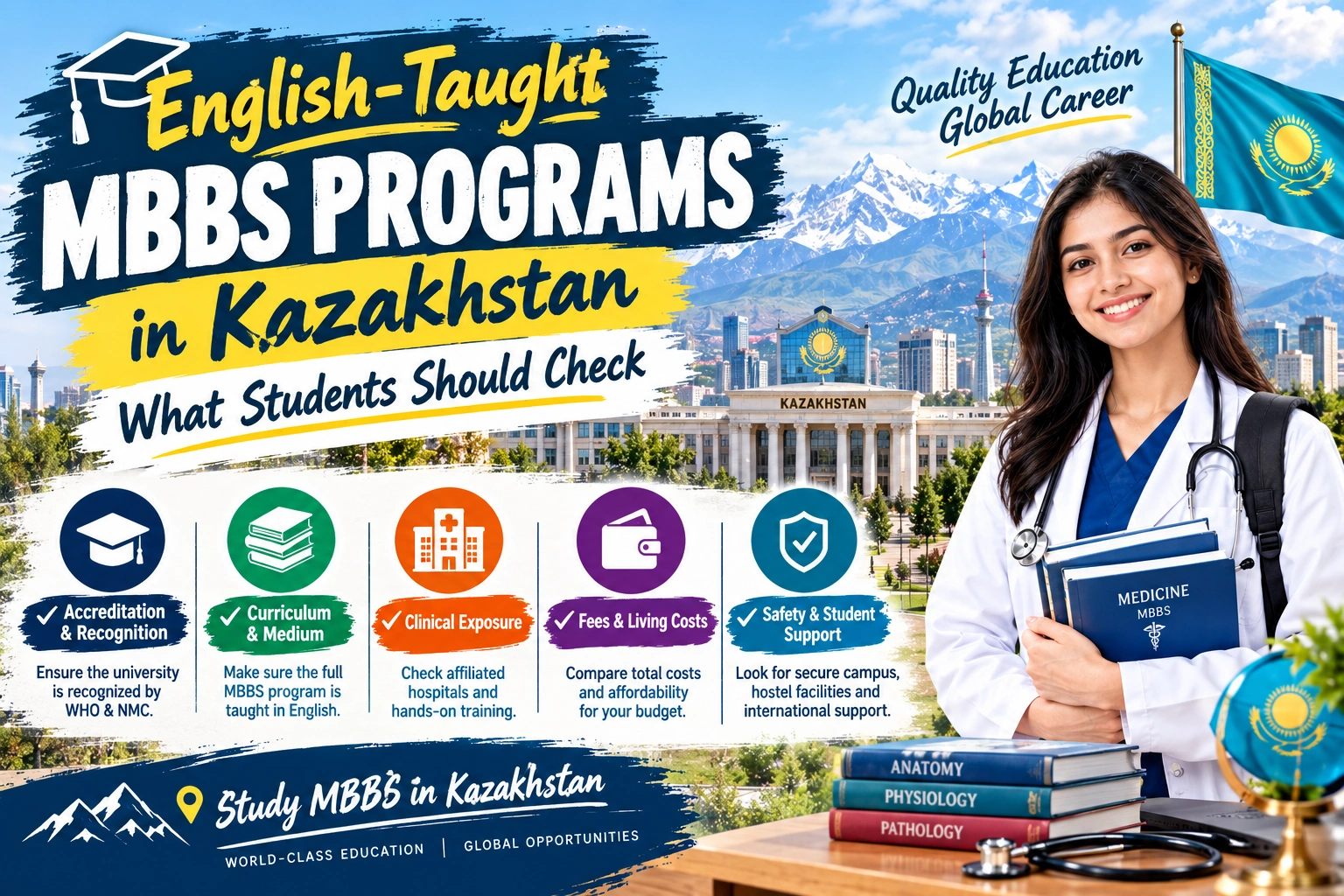
“Complete course in English.” Five words. They look reassuring on a university brochure, especially to an Indian student who doesn’t speak Kazakh or Russian. But what does “complete” actually cover? Lectures? Practical classes? Clinical discussions? Patient interaction? Internship? That’s where the answer becomes less tidy. Several universities offer English-taught medical programmes to international students, making MBBS in Kazakhstan an attractive option for families seeking affordable medical education abroad. Still, an English-medium label shouldn’t be accepted without checking the curriculum, faculty communication, hospital training, course duration, and licensing conditions. Ask more questions now. Fewer problems later.
What Does “English-Taught” Actually Mean?
Start with the exact wording in the university’s official documents. The offer letter, programme description, and curriculum should identify English as the medium of instruction—not merely say that “English support” is available. At some institutions, lectures and examinations may be conducted in English, while patients and hospital staff communicate mainly in Kazakh or Russian. Elsewhere, international students may study separately during the early years and later join mixed clinical groups. A programme can therefore be academically English-medium yet still require a local language for meaningful bedside learning.
Ask the admissions office to confirm:
- Language used during lectures
- Language used in practical examinations
- Language of textbooks and study materials
- Language used for written and oral assessments
- Language used during hospital case discussions
- Availability of English-speaking clinical teachers
- Local-language classes included in the curriculum
Get the answer by email. A telephone assurance is easy to forget and harder to prove.
English in the Classroom Isn’t English in the Hospital
Picture this. The professor explains pneumonia in English, the case sheet contains unfamiliar terms, and the patient answers every question in Russian. The student understands the disease but can’t take the history independently. Very common. Kazakh and Russian are widely used in everyday life and patient communication. International students should expect to learn at least basic medical vocabulary in one or both languages. This doesn’t mean becoming a literary expert. It means asking about pain, fever, duration, allergies, previous treatment, family history, and common symptoms without depending entirely on an interpreter. During MBBS in Kazakhstan, local-language learning should ideally begin in the first year and continue before clinical postings. Check whether language classes are compulsory, how many semesters they cover, and whether they teach medical communication rather than only basic grammar. Honestly, “you won’t need Russian at all” is not a convincing promise for a student who expects to examine local patients.
Check the Exact Degree and Programme Duration
Medical programmes in Kazakhstan may be described as General Medicine, MD, MBBS-equivalent, five years, five-plus-one years, or six years. These terms are sometimes used too casually in advertisements. Indian students should examine the official degree title, academic duration, internship structure, and local licensing pathway. Under the current Foreign Medical Graduate Licentiate Regulations, the National Medical Commission sets conditions related to the duration of study, internship, required subjects, English-medium instruction, clinical training, and eligibility for registration in the country awarding the qualification. Don’t assume that every English-taught programme is automatically suitable for Indian students. Language is only one condition.
Request a semester-wise curriculum showing:
- Total number of academic months
- Subjects taught in every semester
- Beginning of clinical rotations
- Internship duration and location
- Holidays and academic breaks
- Name of the degree awarded
- Eligibility for local medical registration
If the brochure says five years but the agent verbally adds “one-year internship,” ask where that internship appears in the university’s regulations. If it isn’t written, keep asking.
Compare Universities Beyond the English-Medium Claim
A few well-known names frequently researched by Indian applicants include Kazakh National Medical University, Astana Medical University, Karaganda Medical University, Semey Medical University, and West Kazakhstan Marat Ospanov Medical University. Programme availability and teaching arrangements can change between intakes, so verify the 2026 details directly.
A practical comparison may look like this:
|
Area to compare |
What students should verify |
|
Programme language |
English in lectures, practicals and examinations |
|
Clinical communication |
Russian or Kazakh training before hospital postings |
|
Course duration |
Full academic and internship structure |
|
Teaching hospitals |
Hospital names, departments and patient volume |
|
International batch |
Class size and faculty-to-student interaction |
|
Annual tuition |
Official fee, currency and possible yearly increase |
|
Degree eligibility |
Local licensing and Indian regulatory requirements |
|
Student support |
Hostel, visa office, mentoring and grievance system |
Don’t choose a university because it has the largest Indian batch. A familiar community can help with food and adjustment, but very large groups may also mean crowded classes or reduced patient interaction. Likewise, an expensive programme isn’t automatically better. Ask what the extra fee actually provides.
Verify Recognition Without Falling for Marketing Language
Here’s a phrase worth treating carefully: “NMC and WHO approved.” NMC doesn’t provide a simple permanent list that guarantees every foreign medical programme for every Indian student. Eligibility depends on the student’s admission, course, subjects, duration, internship, clinical training, local registration rights, and compliance with the rules applicable to that batch. The World Directory of Medical Schools is useful for checking whether a medical school and programme appear in the directory. Yet WDOMS clearly explains that listing doesn’t itself mean recognition, accreditation, or endorsement. The World Health Organization works on international public health and health systems. It doesn’t personally inspect and “approve” individual foreign colleges for registration in India. So a university logo placed beside the WHO logo doesn’t settle the matter. For an English-taught MBBS in Kazakhstan programme, verify three separate things: the university’s legal status in Kazakhstan, its programme accreditation, and its compatibility with Indian regulations. Separate checks. All necessary.
Eligibility and NEET Requirements for Indian Students
The basic academic route usually begins with Class 12 Physics, Chemistry, Biology or Biotechnology, and English. Indian eligibility commonly requires at least 50% aggregate marks in PCB for general-category candidates and 40% for eligible reserved-category candidates, subject to applicable regulations. Universities may set additional requirements. Indian applicants generally need to qualify NEET-UG before taking admission to a primary medical qualification abroad if they intend to pursue registration in India. The qualifying cutoff changes each examination year. Follow the official NEET website for the result, category-wise cutoff, bulletin, and current instructions. Students don’t usually need the high score required for a government medical seat in India simply to apply abroad. They do, however, need to satisfy the officially declared qualifying requirement and any conditions imposed by the chosen university. Keep the NEET scorecard safely for the entire course. Not only on an old phone. Store several digital copies.
Inspect the Faculty’s English, Not Just the Brochure
A programme may officially use English while individual teaching quality varies from department to department. One professor might explain concepts clearly; another may rely heavily on slides and speak with limited fluency. This happens in many countries, not Kazakhstan alone. Before applying, ask for access to a sample lecture, online orientation, or a conversation with current students. Speak with learners from different years. First-year students can discuss basic science teaching, while fourth- or fifth-year students can explain hospital communication and clinical faculty support.
Questions worth asking include:
- Are lectures interactive or mainly slide-based?
- Can students ask questions comfortably in English?
- Are oral examinations conducted fully in English?
- Do clinical teachers translate patient histories?
- Are separate teachers assigned to international groups?
- Are textbooks, case records and examination papers available in English?
Two or three honest student conversations can reveal more than a polished promotional video.
Look Closely at Clinical Training
Now we reach the part that matters most. Medicine can’t be learned only through English-language presentations. Check the names of affiliated hospitals, the year bedside postings begin, the average number of students in each clinical group, and the tasks international students can perform under supervision. Observing a ward round is useful. Taking histories, examining patients, presenting cases, reading investigations, and discussing management are far better. Students considering MBBS in Kazakhstan should ask whether English-speaking faculty members remain present throughout clinical rotations. If interpreters are used, find out how often. A translator available during one demonstration each week isn’t the same as daily clinical support. Request a written rotation schedule covering internal medicine, general surgery, paediatrics, obstetrics and gynaecology, psychiatry, community medicine, emergency care, and other required disciplines. Large hospital. Impressive building. But will you touch a stethoscope? Ask.
Understand the Cost of an English-Taught Programme
English-medium medical programmes may carry different fees from Kazakh- or Russian-medium courses. Tuition at many universities can fall roughly between USD 3,500 and USD 6,000 per year, though certain institutions or programmes may charge more. Hostel fees may range from approximately USD 500 to USD 1,500 annually. Food, local transport, mobile service, insurance, visa renewal, winter clothing, and personal expenses may add around USD 150–350 per month.
A realistic yearly budget should cover:
|
Expense |
Approximate range |
|
Tuition |
USD 3,500–6,000 |
|
Hostel |
USD 500–1,500 |
|
Food and daily living |
USD 1,800–4,200 |
|
Insurance and medical checks |
Varies |
|
Visa and registration expenses |
Varies |
|
Travel to India |
Depends on route and season |
|
Books, equipment and clothing |
USD 200–600 approximately |
These are broad planning estimates. Exchange rates move, and city-wise costs differ. Get the official 2026 fee schedule from the university, including laboratory fees, examination charges, invitation costs, registration, hostel deposit, and annual fee increases. Fees look low. Sometimes very low. Then the exclusions appear.
Ask Whether the Programme Supports FMGE or NExT Preparation
A foreign medical university’s primary responsibility is teaching its own approved curriculum, not coaching students for an Indian licensing examination. Families should understand that before admission. FMGE continues to be relevant for eligible foreign medical graduates, while NExT has been notified and its implementation schedule must be followed through official NMC notices. Whichever examination applies at graduation, students will need strong concepts, clinical reasoning, and familiarity with Indian public-health programmes and treatment practices. An English-taught programme can help because students study standard medical terminology in English. Still, that alone won’t prepare them for FMGE or NExT. Students should solve MCQs, revise Indian guidelines, practise clinical images, and begin structured preparation during the middle years. Ask whether the university has an Indian student academic cell, examination-oriented study groups, library access to standard English textbooks, or optional FMGE sessions. Treat these as added support, not guaranteed results.
Admission Months and Document Checks
I prefer applications that start early, mainly because rushed admissions create silly mistakes. The main admission cycle commonly runs from late spring through summer for classes beginning around September or October. Some institutions may accept later applications, but invitation letters, visa processing, hostel allocation, and document verification all need time. Exact 2026 deadlines must be checked directly.
Typical documents include:
- Passport
- Class 10 and 12 certificates
- Class 12 marksheet
- NEET scorecard
- Passport-size photographs
- Medical fitness certificate
- HIV test report, if required
- Birth certificate, where requested
- Police clearance, if applicable
- Completed university application form
Check that names and birth dates match across every document. A minor spelling difference can hold up an otherwise simple application.
Pros and Cons of English-Taught Medical Courses
The main advantage is obvious: Indian students can study core medical subjects in a familiar academic language. Standard textbooks, online medical resources, research papers, and FMGE preparation materials are also widely available in English. The limitations are less obvious. Faculty fluency may vary, patients may not speak English, and local-language training may be treated as a minor subject even though clinical students need it daily. An English-medium label can also increase tuition without guaranteeing better bedside exposure. The right programme combines English classroom instruction with serious local-language teaching and organised clinical training. Anything less feels incomplete.
Red Flags Students Shouldn’t Ignore
A university or agent deserves extra scrutiny if you hear claims such as:
- “No need to learn Russian or Kazakh.”
- “Every graduate automatically gets Indian registration.”
- “The five-year course is accepted everywhere.”
- “WDOMS listing guarantees NMC eligibility.”
- “Pay today or the final seat disappears.”
- “Internship details will be decided after graduation.”
- “All fees are fixed,” without a written schedule.
- “Clinical exposure is excellent,” without naming hospitals.
Honestly, vague answers at the admission stage usually become bigger problems later. Ask for documents. If they aren’t provided, reconsider.
Frequently Asked Questions
Is the entire medical course taught in English?
Selected universities offer English-medium programmes, but the extent of English used in clinical settings varies. Confirm the language of lectures, practical examinations, case discussions, and internship separately.
Do Indian students need Russian or Kazakh?
Basic local-language ability is highly useful and may be essential for patient interaction. Even if classroom teaching is in English, hospital communication often isn’t.
How long is an English-taught medical programme?
Programmes may be advertised as five, five-plus-one, or six years. Indian students must verify the complete academic and internship structure against current NMC regulations before admission.
Is an English-medium degree valid in India?
The medium of instruction is only one condition. Validity and registration eligibility also depend on programme duration, subjects, clinical training, internship, local licensing rights, and the regulatory pathway applicable in India.
What is the approximate annual fee?
Tuition may range from about USD 3,500 to USD 6,000 per year at many institutions, excluding hostel and living expenses. Always request the current official quotation for your chosen programme.
Can students prepare for FMGE alongside university classes?
Yes. Students can begin with topic-based MCQs in the early years and move toward structured revision and full-length tests during the clinical years. University study and licensing-exam preparation should support each other.
Conclusion
An English-taught programme can make medical studies easier for Indian students, but the phrase needs to be tested. Is the faculty comfortable teaching in English? Are examinations fully English-medium? Does local-language training prepare students for hospital work? Is the internship properly defined? Does the full course satisfy current Indian requirements? Those answers matter far more than a colourful brochure. Before selecting MBBS in Kazakhstan, compare official curricula, teaching hospitals, complete fees, student feedback, language arrangements, and NMC-related conditions. English-medium education is useful. Genuine clinical learning is essential. You need both.