The number of Indian students pursuing MBBS in Kazakhstan has increased over time, thanks to its affordable fee structure, easy admission process (entry is without entrance exam), the English language, and the global recognition of its universities. The first concern students and parents have when thinking of pursuing the program is, “How long is the MBBS course in Kazakhstan?”
To help answer that concern this document outlines the total course duration, the yearly breakdown of the academic structure, and the internship and program alignment with the National Medical Commission (NMC) for India.
Duration of MBBS in Kazakhstan
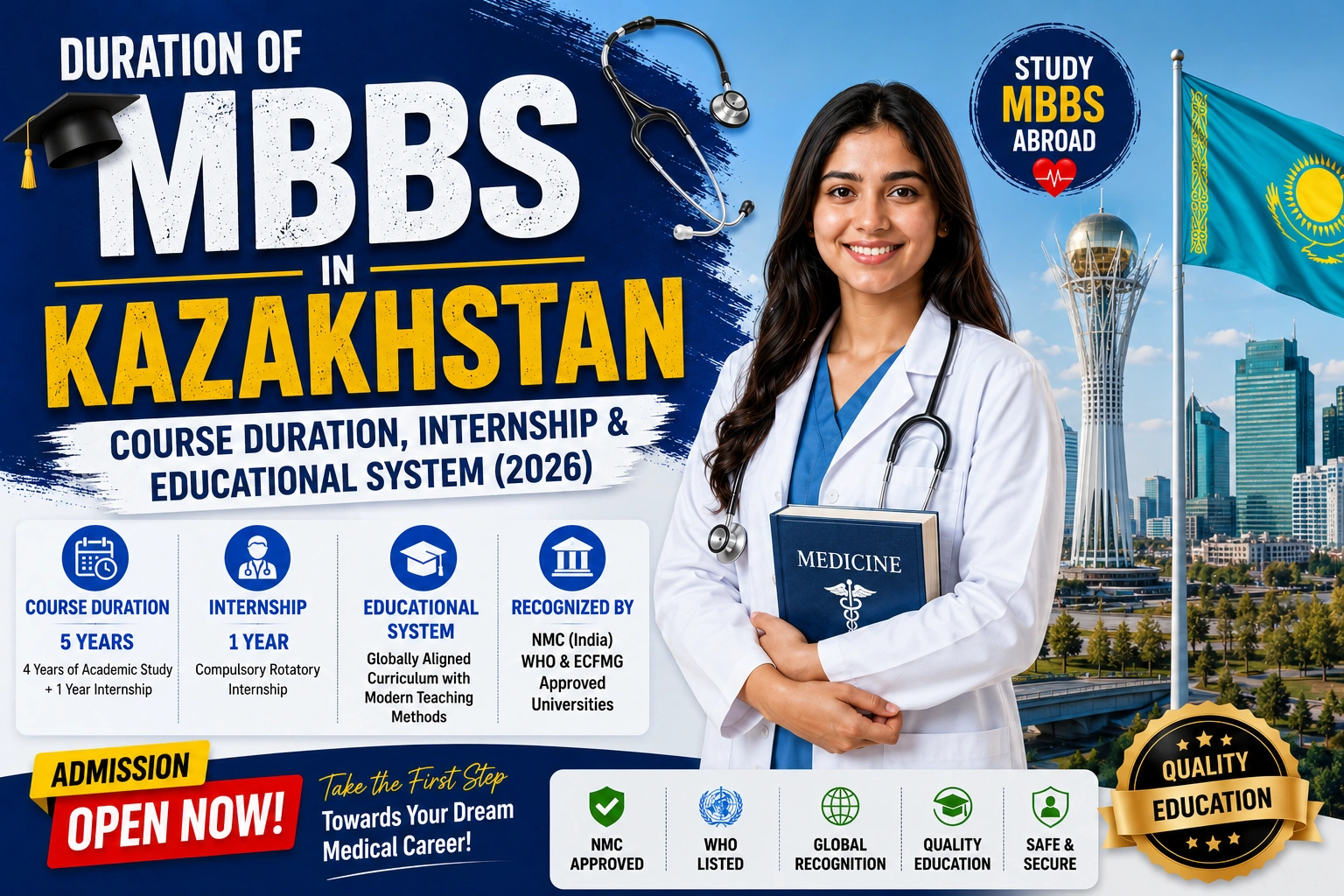
Indian Students pursuing MBBS in Kazakhstan have a 6-year duration, which includes 2 main segments:
- 5 years (54 months) of academic training
- 1 year (12 months) of a compulsory, rotating internship at hospitals associated with the university
This structure is often referred to as a 6-year course, and while that may be true, the academic and internship components are separated for the purposes of regulation. The structure of 54 months of Theoretical and Clinical study, followed by a 12-month internship, is in accordance with the National Medical Commission’s (NMC) guidelines for Indian students pursuing a medical degree abroad.
Kazakhstan MBBS program takes a little longer than India's MBBS (5.5 years total). However, taking into consideration Indian regulations around the degree (54+12 months), no matter what country it is done, its academic depth will remain the same.
Year-Wise Academic Structure
There is tremendous value in understanding the curriculum year wise. If you are hoping to do your MBBS in Kazakhstan in 2026, this will help you understand how the program will look in the years to come.
Year 1 and Year 2: Pre-Clinical
Of the basic medical sciences, these years cover the following subjects:
- Anatomy
- Physiology
- Biochemistry
- Histology
These subjects will tend to require more lab work or class time and precede the teaching of applied or clinical subjects.
Year 3 and Year 4: Para-Clinical
Students will learn the following para-clinical or applied subjects:
- Pathology
- Pathophysiology
- Pharmacology
- Microbiology
Students will begin to learn the clinical specialties and be exposed to the clinical environment (medicine, surgery, pediatrics, obstetrics and gynecology) at this level of their studies.
Year 5: Clinical Phase
In Year 5, you advance further into rotations and specializations for clinical training. You can focus on the following areas:
- General Surgery
- Internal Medicine
- Obstetrics and Gynaecology
- Dermatology, Psychiatry, and Orthopedics
- Emergency and Critical Care Medicine
By the end of Year 5, students achieve the complete 54-month training period stipulated by the NMC and are prepared to enter full-time training in hospitals.
Year 6: Compulsory Internship
The last of the years is a 12-month compulsory rotating internship, with students assigned to various hospital departments for the purpose of gaining further clinical experience. The internship is compulsory for both graduating from a medical university of Kazakhstan and being eligible to take the licensing exam in India. The aim of this internship is to assist students in the process of adjusting to the clinical environment, including exposure to the emergency, surgical, and outpatient departments.
Importance of the Internship Year
The internship year is crucial in developing the skills necessary to become a competent doctor. It is the year when students:
- Have their first contact with real patients albeit under some level of supervision.
- Start the process of relating some of the knowledge they gained in the classroom with what happens in practice in the hospital.
- Begin developing the confidence that is necessary for any medical doctor who is going to practice on his/her own.
- Start preparing for the examination that is necessary to practice medicine in India after going through the foreign medical training.
The best universities that offer MBBS in Kazakhstan tailor their internship programs in a manner that meets the international standards of clinical training. This is the main reason why choosing a good university is so essential. A good university is not just recognized by the Ministry of Education and Science of Kazakhstan, but also by the Indian and other global regulators.
Regulatory Registration: NMC, WHO, WDOMS
You need to look at university recognition if you want to see if your medical degree will be validated in India and not just the course duration. You need to look at the National Medical Commission (NMC).
The NMC is the highest regulatory body in India, and supervises medical education and practice. The Medical Council of India (MCI) was the predecessor of the NMC, and maintained a list of approved foreign Medical Universities. After the NMC replaced the Medical Council of India (MCI), that responsibility was also eliminated. Instead, the NMC advises students to check the listing of the World Directory of Medical Schools (WDOMS). In addition to listing medical schools, WDoMS also contains the foreign medical licensing requirements, including the licensing examinations in India, for medical graduates who completed their MBBS in Kazakhstan.
World Directory of Medical Schools (WDOMS)
The World Directory of Medical Schools is the internationally recognized database of medical schools maintained by the WFME and the FAIMER. The NMC now uses the WDOMS listing as the primary criterion for the recognition of a foreign medical institution. Before making applications, candidates are advised to check the listing of the particular University in Kazakhstan on the WDOMS website.
World Health Organization (WHO)
The WHO does not accredit medical schools, and does not have a direct role in the evaluation of medical education. However, the health education frameworks and the quality of health education standards developed by the WHO help to determine the standards and the minimum requirements for evaluating the quality of curricula, the clinical training and the health education of the various national and international medical councils. Generally, medical schools that orient their programs in line with the WHO health education standards are likely to provide clinical training that is more uniform and consistent across countries.
NEET: The Compulsory Admission Requirement
No medical aspirant from India can pursue MBBS in any of the medical schools in Kazakhstan or in any foreign country, irrespective of the duration of the course or the name and recognition of the medical school, without the National Eligibility cum Entrance Test (NEET). According to the NMC guideline, qualifying NEET is mandatory for enrolling in any medical school abroad. Also, since the NEET scorecard is generally valid for a limited duration, it is recommended that candidates plan their applications to medical schools abroad within that timeframe.
Eligibility Requirements for Indian Students (2026)
Kazakh Universities require the following for students wanting to pursue MBBS in Kazakhstan alongside valid NEET qualification:
- For admission to MBBS in Kazakhstan, 10+2 (12th grade) with a minimum of 50% in Physics, Chemistry and Biology (PCB) (Relaxation of 10% as per the NMC for SC/ST/OBC categories)
- Meeting the NEET qualification of that particular admission year
- Attain a minimum age of 17 years on or before December 31st of that admission year
- No TOEFL or IELTS are required since the medium of instruction in most Kazakh Universities is English.
MBBS in Kazakhstan vs MBBS in India: Duration
|
Feature |
MBBS in India |
|
Academic duration |
4.5 years |
|
Internship |
1 year |
|
Total duration |
5 years |
|
Medium of instruction |
English / Regional languages |
|
Entrance requirement |
NEET (mandatory) |
|
Feature |
MBBS in India |
|
Academic duration |
4.5 years |
|
Internship |
1 year |
|
Total duration |
5 years |
|
Medium of instruction |
English / Regional languages |
The validation of a Medical Degree by the NMC is dependent on the regulatory requirement of 54 months of structured classroom instruction and clinical training plus a 12 months of Internship. This is the same for all foreign Medical Universities.
Conclusion
Kazakhstan’s MBBS program takes 6 years total – 5 years of classroom based training and 1 year of internship. This structure is partially designed for compliance with the standards of international medical education and the NMC for Indian students. Prior to enrollment, make sure the university is on the WDOMS list, check your NEET eligibility, and understand that the internship is equally important as the academic training that was prior to it.
Recognizing the relevance of this structure early on will help you build a better, more organized, and effective strategy for your goal of being a certified medical doctor.