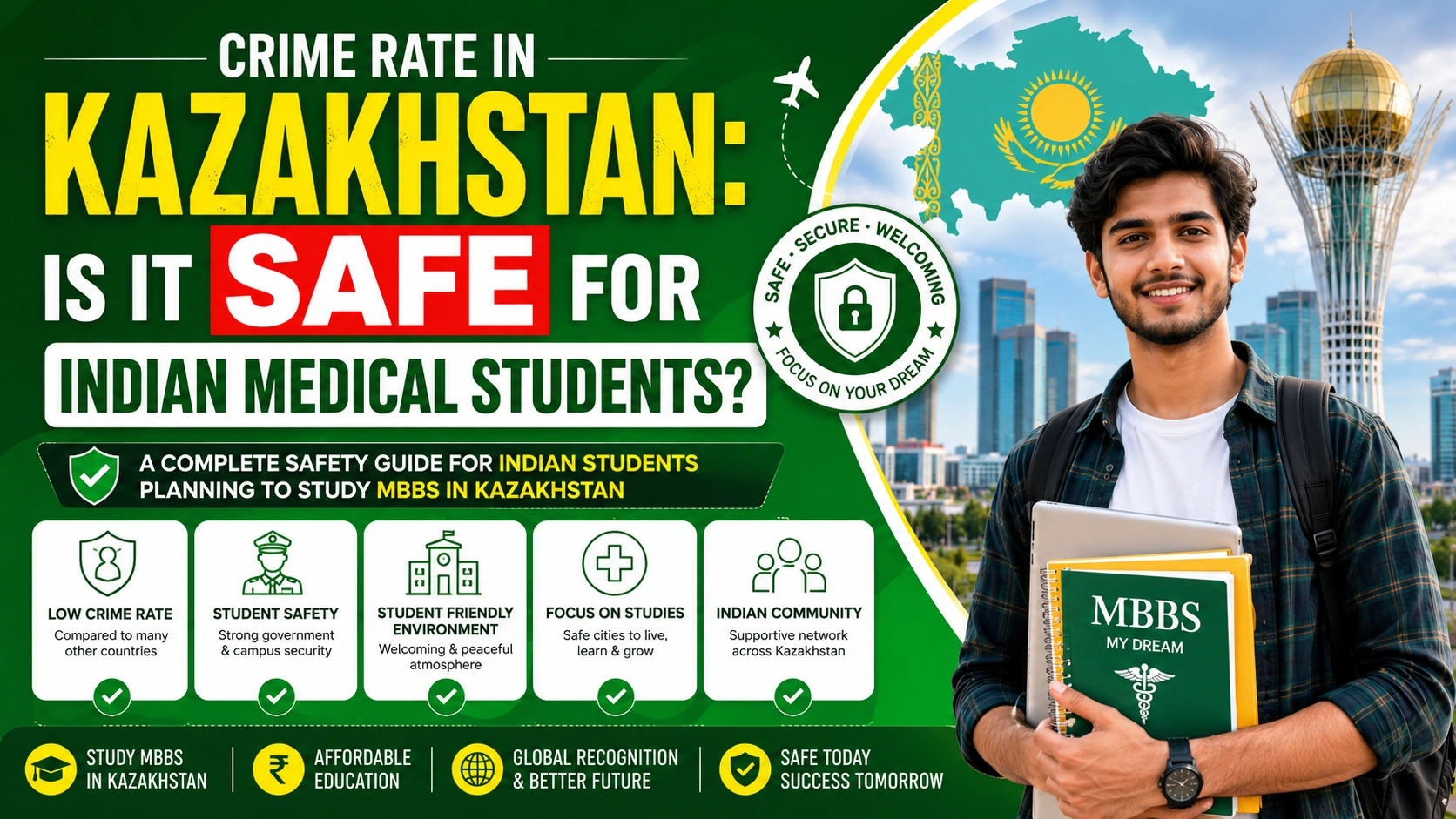
Kazakhstan is one of the most frequented destinations among Indian students, as it provides accessible and internationally acknowledged medical courses. It is only natural for the parents of Indian medical aspirants to have concerns related to their children's safety. This blog aims to analyze crime data and assess safety in Kazakhstan, in order to help parents understand the actual situation and decide whether it is wise to pursue an MBBS in Kazakhstan or not.
Understanding Kazakhstan as a Study Destination
Kazakhstan is the ninth largest country by area and is situated at the intersection of Europe and Asia. It is one of the best places to pursue an MBBS from abroad, considering not only the inexpensive tuition structure, but also the English medium courses and the advanced infrastructure that is recognized by leading medical institutions around the world.
It is apparent that many students from India, Pakistan and the greater part of Central Asia want to study medicine in Kazakhstan. However, safety is one of the most important factors that ultimately help students thrive in the chosen country and not stay in constant fear.
What Can be Understood from Crime Statistics?
Many parents from post-Soviet countries, unlike what many would assume, have a more optimistic perspective regarding the crime situation in Kazakhstan.
- The intentional homicide rate in Kazakhstan is about 2.5 per 100,000 people. The global average is 5.2. This puts Kazakhstan in the 101st place out of 195 countries in the world. The bulk of the countries in the world have a higher homicide rate than Kazakhstan.
- The travel advisory placed by the U.S. Department of State ranks Kazakhstan at Level 1 – "Exercise Normal Precautions", which is the lowest and safest travel advisory tier, a rating that has been consistent in the last couple of years.
- Kazakhstan has reported a noticeable drop in crime, and with the improvement of public surveillance systems, including millions of CCTV cameras in cities to assist law enforcement and rapid response to emergency situations.
- On the 2025 Global Peace Index, Kazakhstan was ranked as the safest of the Central Asian countries and was ranked ahead of its neighbors to the west, Uzbekistan and Kyrgyzstan, to the south, Tajikistan and Turkmenistan.
- Astana, the capital, has been ranked among the relatively safer cities in the world.
This is a positive reflection of the low perceived crime in Kazakhstan and a demonstration that they are a relatively safer nation that is still not crime-free.
What Kind Of Crime Exists?
Perceptions and reality can be markedly different in terms of concern about 'crime in Kazakhstan. Are there violent crimes targeting foreigners? Are there kidnappings? Are there gangs? No, Indian students are far more likely to encounter the following mundane concerns:
- Petty theft and pickpocketing: Large cities such as Delhi, Mumbai, and London are home to pickpockets. Almaty and Astana's crowded markets and public transport are no different. All that is necessary is to be aware of one's surroundings in a crowded location.
- Unregulated taxis raise costs: Drivers with no regulation of their services sometimes overcharge students or tourists. Using the available, official taxi services is all that is necessary.
- Scam phone calls: Kazakhstan has phone scams where the fraudster calls pretending to be a bank, however these scams target local Kazakh speakers with local bank accounts and are not a concern for international students.
- Other crime in nightclubs: Reports of drink spiking and other isolated crimes occur in nightlife districts. The world recommends basic measures such as avoiding leaving drinks unattended and moving in groups.
Kazakhstan is not home to violent street crime, tourist-targeted gangs, and kidnappings. Law enforcement is present and visible, particularly in areas of high concern such as university campuses, public transit, and city centers.
How does MBBS in Kazakhstan Compare With Other Destinations?
Naturally, parents considering MBBS in Kazakhstan 2026 will compare this with popular alternatives (Russia, the Philippines, Georgia, and even the private colleges in India). Some things to consider:
- Kazakhstan has a lower homicide rate than numerous countries that are more frequently suggested for studying abroad.
- For Kazakhstan's major cities, safety perception ratings (as a world average) are comparable to, and in some instances better than, major cities in the US, France, Italy, and Australia.
- Kazakhstan has had a Level 1 Travel Advisory for many years, an honor bestowed on only a few countries on the planet.
Of course, this does not apportion Kazakhstan the rank of the "safest country on the planet." However, it does show that it is at a level of safety that International Students can expect and, in fact, safer than many destinations that Indian families consider without a second thought.
Life on Campus: What Do Indian Students Experience
While statistics convey a lot, the day-to-day experiences of students is what is of utmost importance to parents. This is what most students studying MBBS in Kazakhstan have to say:
- At most acknowledged medical universities, the international students' hostel accommodation is dedicated and comprises entrance control, security personnel, and CCTV.
- Almost all campuses have large Indian student populations, so newcomers seldom feel lonely as seniors help juniors in the settling-in period during the first few weeks.
- Near the major university campuses of Almaty and Karaganda, there is a steadily increasing presence of Indian restaurants and grocery stores.
- University organized support systems include international student offices, and in many instances, coordination with the Indian embassy to respond to emergencies.
- Cold winters are, comparatively, the main adjustment to life as an international student in the Central Asian country. Kazakhstan's geographical positioning results in a serious winter; chilly weather is a life adjustment, not a safety concern, as students have indicated.
Healthcare and Emergency Preparedness
Access to quality care is an important consideration for any international student. It is as important as the concern for one's physical safety. The major cities of Kazakhstan, particularly Almaty and Astana, possess hospitals that are modern and at least some of them are internationally accredited. They also have well developed emergency services. Private clinics even have English speaking staff. Because of the limited medical care that is available in the countryside, comprehensive travel and health insurance is necessary, and especially one that covers medical evacuation.
Recognition and Regulatory Compliance: The Real Safety Net for Your Career
Physical safety is half the concern, and arguably the same amount of concern is if your degree is actually going to be useful when you return to India. Regulatory recognition is where this concern comes in and requires real homework for every family.
- The first step to applying for a postgraduate medical program in any country is to make sure that the school is listed in the World Health Organization's Directory of Medical Schools. If a medical school is not listed there, the family has to consider the implications that will have for that student's future and that school's affordability and convenience.
- You should also look at the World Health Organization (WHO) benchmarks for medical education. WHO benchmarks are qualitative international frameworks for medical education that set standards for medical education and are used by most medical councils and licensing authorities.
- When foreign university graduates return to India, they have to pass the new licensing exam to be eligible to practice medicine. Foreign graduates need to check the official guidelines and the list of recognized foreign medical institutions made by the National Medical Commission (NMC) of India, as they may change the eligibility criteria anytime.
- Finally, qualifying the National Eligibility cum Entrance Test (NEET), the entrance test for all medical colleges in India, is a mandatory requirement for Indian students aspiring to pursue MBBS abroad. Indian students cannot practice medicine with a foreign MBBS degree without qualifying NEET, regardless of the medical school's ranking.
A foreign medical school in an unrecognised country that is safe is still a bad choice. Regulatory recognition and safety must be assessed together.
Practical Safety Tips for Indian Students Heading to Kazakhstan.
If you or your child is moving to another country to study, here are safety suggestions you should consider to mitigate most risks:
- Do not make housing arrangements outside of university provided or verified housing before arrival.
- Register with the Indian Embassy in Kazakhstan upon arrival.
- Memorize or save your emergency contacts. Keep a digital and physical copy of important documents.
- Use verified transport apps to order a transport to avoid unmarked taxis, especially late at night.
- Connect with the senior Indian students on campus. They may provide the best advice as they know the ins and outs on the essentials.
- Schedule weekly family check-ins to reduce anxiety for both you and them.
- Secure a solid health care plan before leaving. Know the plan and its limits.
The Real Question Your Parents Want The Answer To
Parents asking, "Is Kazakhstan safe?" really mean to ask, "Will you look after my child? Will they be able to study without the fear of something bad happening? Will they come home with a degree that actually means something?" Considering the statistics, the low homicide rates, the Level 1 travel advisory, decreasing crime rates, campus security, and the existing Indian educated community, for almost all students, the answer is yes.
Even with all that, safety abroad is as safe as anywhere else. Choosing a WDOMS listed university, being aware of your surroundings, using good judgement and connecting with trustworthy Indian families and local networks provide a sense of safety. Parents - Stay in contact with reliable local networks and family back home.
Conclusion
The safety and crime rates in Kazakhstan are not only better than most of the countries that Indian families consider "obviously safe," and its big university cities are equipped with modern infrastructure, law enforcement, and active support systems for international students. For almost all students, the real risks are the everyday, avoidable kind. Petty theft, scam calls, unlicensed taxis, not violent crime. If globally recognized medical education, safety, and affordability tick your boxes, then you should consider Kazakhstan. Check with a counselor to see how you can explore the recognized universities, application dates for medical programs, current costs, and the eligibility criteria for pursuing your MBBS in Kazakhstan for Indian students. A counselor will be able to provide options for you based on your NEET score and budget.