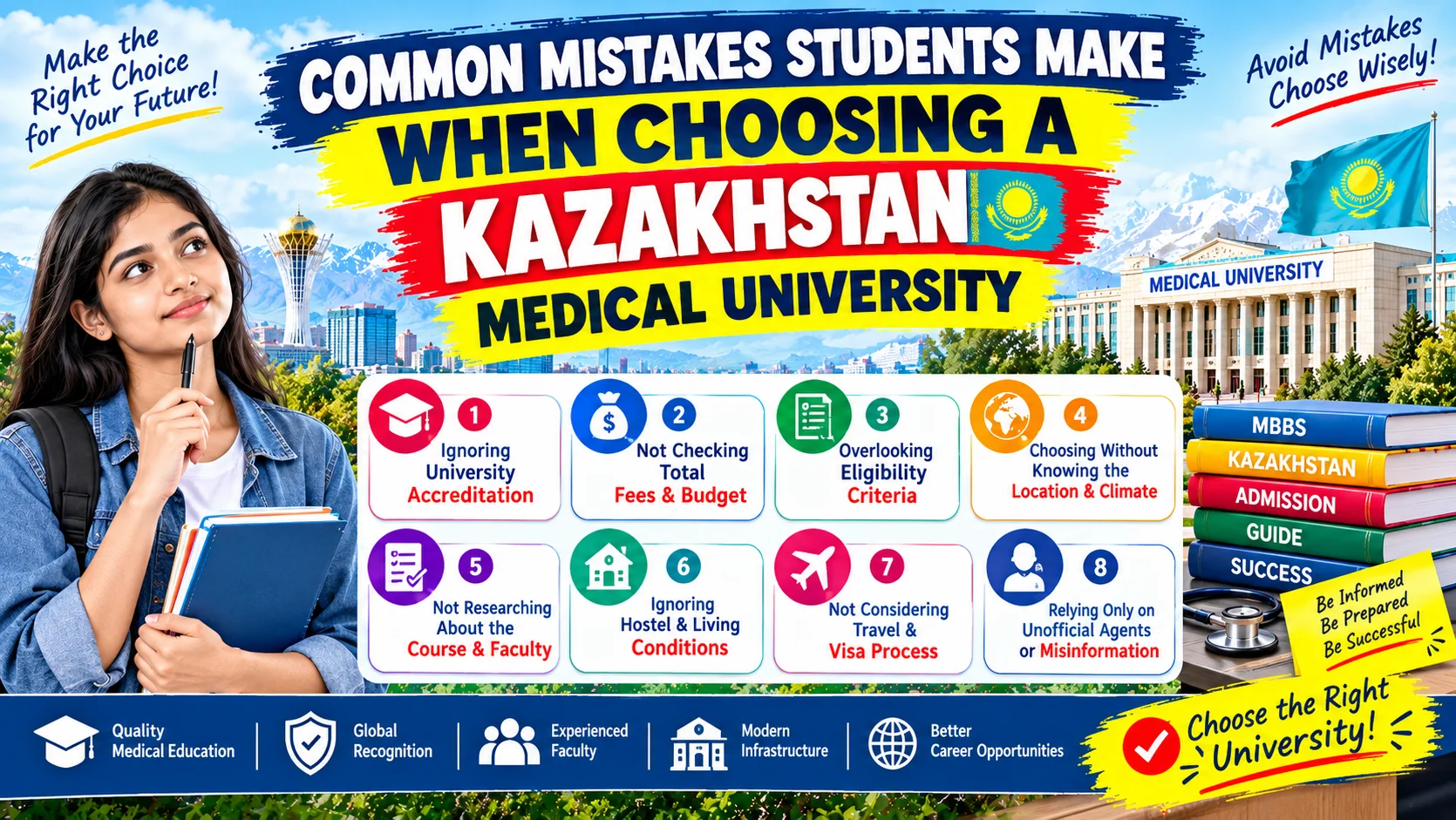
A low-fee advertisement can look convincing. The university name sounds established, the campus photographs are impressive, and someone on the phone promises admission within three days. Done deal? Not quite. Choosing a university for MBBS in Kazakhstan requires more investigation than comparing two fee charts because a wrong decision can affect your clinical training, Indian registration eligibility, and six years of family savings. Kazakhstan has several medical institutions offering programmes for international students, but their course structure, teaching language, hospital access, hostel quality, and total expenses can differ sharply. Fees may be affordable. Very affordable. But the cheapest offer isn’t automatically the safest academic option. Here are the mistakes Indian students and parents repeatedly make—and the practical checks that can prevent them.
Mistake 1: Treating “NMC Approved” as a Complete Guarantee
Does an “NMC-approved university” label prove that every course offered there is suitable for Indian students? No. This phrase is commonly used in advertisements, yet students must evaluate the exact qualification, course structure, internship, training location, and licensing conditions against current National Medical Commission regulations. The Foreign Medical Graduate Licentiate Regulations, 2021 contain requirements related to subjects, study duration, internship, clinical training, teaching medium, and eligibility for medical registration in the country where the qualification is awarded. Their applicability can depend on the student’s admission date and other facts.
Before paying anything, request written answers to these questions:
- What is the official title of the medical degree?
- What is the complete duration, excluding language or foundation classes?
- Where will the internship and clinical training take place?
- Does the qualification make a graduate eligible to seek a medical licence in Kazakhstan?
- Is any part of the programme conducted online or in another country?
- Are Indian students enrolled in the regular medical programme or a separate international track?
A university’s general reputation cannot correct a course that fails the applicable Indian requirements. This part needs paperwork. Not promises.
Mistake 2: Assuming a WDOMS Listing Means Automatic Recognition in India
A medical school’s presence in the World Directory of Medical Schools is an essential verification point, but it isn’t an automatic registration certificate for India. WDOMS is a directory. It doesn’t decide whether a particular graduate meets Indian licensing regulations. Search for the exact institution and campus, then inspect the programme details carefully. A similarly named university, a newly opened branch, or a private school connected with a larger institution may have a separate entry—or no suitable entry at all. Students planning MBBS in Kazakhstan should save a dated copy or screenshot of the relevant directory entry during admission. They should also check whether the qualification name, awarding institution, and campus on the directory match the documents issued by the university. The same caution applies to claims such as “WHO recognised.” The World Health Organization doesn’t give individual medical colleges a personal approval guaranteeing registration in India. Honestly, these labels are used far too casually.
Mistake 3: Choosing Only by the Lowest Tuition Fee
The first figure shown in a brochure is usually tuition. The amount your family will actually spend is something else. Annual tuition at several Kazakhstan medical universities may fall roughly between USD 3,500 and USD 6,500, though some institutions or international programmes can charge more. Hostel charges may range from around USD 600 to USD 1,500 per year. Add food, insurance, visa or residence-related expenses, registration charges, winter clothing, books, local transport, flights, currency conversion, and personal spending.
A rough comparison may look like this:
|
Expense |
Approximate Range |
|
Annual tuition |
USD 3,500–6,500+ |
|
Hostel per year |
USD 600–1,500 |
|
Food and personal expenses |
USD 150–300 per month |
|
Insurance and administrative costs |
USD 200–600 per year |
|
Return flight from India |
₹35,000–₹80,000, depending on route and season |
|
Winter clothing and initial setup |
₹25,000–₹60,000 |
|
Coaching or licensing preparation |
Varies by platform and study plan |
These are planning ranges, not university quotations. Exchange rates change, fee policies change, and Almaty or Astana can cost more than smaller cities. Ask for the latest official fee letter directly from the institution. One more thing. Get clarity on whether fees are fixed in tenge, US dollars, or another currency. A family budgeting in rupees can face a noticeable increase over six years because of exchange-rate movement.
Mistake 4: Believing That “English Medium” Covers Everything
The brochure says English medium. Fine. But what does that mean inside the classroom, during practical sessions, and beside a patient? Some programmes use English for lectures and examinations while clinical communication happens mainly in Kazakh or Russian. That is understandable; local patients naturally speak local languages. The problem begins when students assume they won’t need either language and later struggle to take histories or understand ward discussions.
Before selecting a programme, ask:
- Are all core lectures conducted in English?
- Are textbooks, examinations, and internal assessments in English?
- Do teachers explain difficult topics mainly in Russian?
- Is medical Russian or Kazakh taught from the first year?
- From which year does hospital exposure begin?
- Are translators available during early clinical postings?
A basic working knowledge of the local language is not a decorative extra. It directly affects clinical learning. Students considering MBBS in Kazakhstan should treat language classes seriously from semester one, even if admission advertisements say “100% English.”
Mistake 5: Ignoring the Real Course and Internship Structure
Six years written in bold letters doesn’t explain how those six years are divided. Some programmes may describe five academic years plus one year of internship, while others may use a different structure. What matters is whether the complete arrangement meets the rules applicable to an Indian foreign medical graduate. Under relevant NMC regulations, students may need a minimum prescribed duration of medical education, mandatory subjects, hands-on clinical training, and a required internship in the same foreign institution or country, subject to the exact regulatory wording and their admission date. Don’t assume an internship can simply be completed later in India to repair a deficient foreign programme.
Ask for:
- A year-wise curriculum
- The number of teaching weeks and clinical hours
- Internship rotation details
- Names of affiliated teaching hospitals
- Written confirmation of the awarding qualification
- Local licensing or registration eligibility after graduation
If the university representative avoids sharing these documents, pause. A serious institution should be able to explain its own course.
Mistake 6: Selecting a University Without Checking Hospital Exposure
A modern-looking building tells you almost nothing about patient volume. Medical education needs laboratories and lecture halls, yes, but it also needs real wards, supervised examination, case discussion, emergency exposure, and consistent interaction with patients. Ask current third-, fourth-, and fifth-year students about their normal clinical day. Not the student chosen by an admission agent for a promotional call. Speak with at least three students independently.
Useful questions include:
- How many students attend one clinical group?
- How often do students enter hospital wards?
- Can international students take patient histories?
- Are clinical postings regular or occasional visits?
- Which hospitals are formally affiliated?
- Do faculty members conduct bedside teaching?
- Is patient exposure delayed because of language difficulties?
This is where many low-cost choices become expensive mistakes. A student may save ₹2 lakh on tuition and then graduate with weak clinical confidence.
Mistake 7: Not Checking NEET Eligibility Before Admission
For Indian students covered by the applicable rules, qualifying NEET-UG before joining a foreign medical course is necessary. Admission abroad without the required NEET qualification can create major problems later when the student seeks registration in India. Qualification is based on the prescribed percentile and corresponding score for that examination year. The exact marks change annually. Students should verify their result through the official NEET website and keep the admit card, scorecard, application confirmation, and related documents safely. Don’t rely on statements such as “NEET is needed only after graduation” or “the university doesn’t ask for NEET.” The foreign university’s admission policy and India’s registration conditions are separate matters.
Mistake 8: Trusting Unverified FMGE Pass-Rate Claims
“Highest FMGE passing ratio.” You’ll see this everywhere. The trouble is that many advertisements provide no batch size, examination session, candidate count, or source. Suppose an institution claims an 80% result, but only five graduates appeared and four qualified. Another may show a lower percentage from a much larger batch. Without context, the comparison is nearly meaningless. Students selecting MBBS in Kazakhstan should ask for verifiable, batch-wise information and avoid treating a consultancy’s infographic as official evidence. More importantly, evaluate what the university actually provides:
- Strong teaching in basic sciences
- Regular internal assessments
- Clinical case discussions
- Access to Indian licensing-exam resources
- A stable academic calendar
- Support for document preparation after graduation
An FMGE or NExT result ultimately depends heavily on personal preparation. No university can guarantee a pass, whatever the salesperson says.
Mistake 9: Applying Too Late and Accepting Whatever Is Available
Kazakhstan medical admissions commonly centre around the autumn intake, often with classes beginning around September or October. Application timelines differ by institution, and visa processing, document translation, invitation letters, and travel arrangements take time. Students who wait until the last few weeks may be pushed toward whichever seat is easiest to sell. Then the checking stops. University selection, hostel review, fee verification—everything becomes rushed. A safer approach is to begin research several months before the expected intake. Shortlist three or four institutions, compare their written offers, confirm the last admission date, and keep enough time for document correction. Names on passports and academic certificates must match. Even a small spelling mismatch can slow the process.
Mistake 10: Paying Money Without a Written Fee Breakdown
A WhatsApp message isn’t a fee contract. Before transferring funds, obtain an official offer or admission letter and a complete breakup of every payment.
The document should clarify:
- Tuition fee for each year
- Hostel charges and room type
- University registration charges
- Medical insurance
- Visa or residence-permit expenses
- Translation and notarisation costs
- Airport pickup, if chargeable
- Consultancy service fee
- Refund and cancellation terms
- The authorised bank account receiving the payment
Avoid cash payments without receipts. Also be cautious if someone asks you to transfer full course fees into a personal account. Pay the university directly wherever its official procedure permits. Parents should calculate the entire six-year expense with at least a 10–15% contingency amount. Fees rise. Airfares jump. Phones break. Real budgets need breathing space.
Mistake 11: Ignoring the City, Hostel, and Daily Life
I’ve noticed that students spend weeks comparing university rankings and ten minutes checking where they will actually live. Strange, because accommodation affects health, attendance, safety, food, and study time every day. Almaty is large, connected, and generally costlier. Astana has severe winters and temperatures can fall far below freezing. Shymkent is usually warmer. Karaganda and Semey offer different living conditions again. The “best city” depends on budget, climate tolerance, university location, and personal comfort.
Ask for recent hostel videos, preferably recorded by current residents. Check:
- Distance from academic buildings and hospitals
- Heating during winter
- Room occupancy
- Washroom and kitchen arrangements
- Security and entry timings
- Availability of Indian food
- Internet reliability
- Separate accommodation arrangements, where required
Don’t choose a medical university as if you’re choosing only a classroom. You’re choosing six years of daily life.
Mistake 12: Forgetting the FMGE or NExT Pathway
Admission is only the first checkpoint. Indian graduates must satisfy the licensing pathway applicable when they return, which may include the FMGE or the notified NExT framework, document verification, and internship or registration conditions. NExT implementation details and applicability have changed across official discussions and notices, so students shouldn’t accept a fixed claim without checking current NMC information. The better strategy is simple: build strong concepts, study all major subjects, practise clinical MCQs, and follow official updates.
A student pursuing MBBS in Kazakhstan can begin light Indian-exam preparation from the first year:
- Years 1–2: master Anatomy, Physiology, and Biochemistry
- Years 3–4: connect Pathology, Pharmacology, Microbiology, Forensic Medicine, and Community Medicine
- Years 5–6: focus on clinical subjects, case-based questions, images, and full mock tests
Preparation after graduation is possible. Starting earlier is much kinder to your sleep.
A Practical University-Selection Checklist
Use this before finalising any institution:
- Verify the exact university and campus on WDOMS
- Read the NMC rules applicable to your admission year
- Confirm NEET qualification
- Obtain the year-wise curriculum
- Check course and internship duration
- Confirm eligibility for local medical licensing
- Speak independently with current senior students
- Review teaching hospitals and patient exposure
- Confirm the real classroom and clinical language
- Compare the total six-year cost, not only tuition
- Read hostel and refund conditions
- Pay only through traceable, authorised channels
FAQs
Is Kazakhstan a suitable country for Indian medical students?
It can be suitable for students who select a compliant programme, adapt to the climate and language, and prepare consistently for Indian licensing requirements. The country alone doesn’t determine quality; the institution and course structure matter more.
What is the approximate cost of studying medicine in Kazakhstan?
Depending on the university, city, exchange rate, and lifestyle, the combined six-year expense may roughly fall between ₹25 lakh and ₹40 lakh or higher. Always verify the latest official fee quotation and keep a contingency fund.
Is every WDOMS-listed Kazakhstan university valid for India?
No. WDOMS listing confirms directory information, not automatic eligibility for Indian registration. Students must separately check the programme against applicable NMC regulations.
Is NEET required for admission?
A Kazakhstan university may have its own admission policy, but eligible Indian students planning to practise in India must meet the NEET requirement under the applicable Indian rules. Check the official NEET and NMC notices for your batch.
Which city is best for medical students in Kazakhstan?
There is no single answer. Almaty and Astana offer major-city facilities but can cost more, while cities such as Karaganda, Semey, and Shymkent may offer different fee and lifestyle advantages. University quality should come before city popularity.
Can an agent guarantee an FMGE or NExT pass?
No. An adviser can assist with university comparison and admission paperwork, but nobody can guarantee a licensing-exam result. Academic quality, clinical exposure, preparation, and revision decide far more.
Conclusion
The right university won’t always be the cheapest, most famous, or most heavily promoted one. It will be the institution whose medical programme fits current regulatory requirements, provides meaningful clinical training, charges transparent fees, and suits the student’s academic ability and family budget. Take your time. Ask awkward questions. Request documents. If you’re comparing universities for MBBS in Kazakhstan, examine the complete six-year pathway before accepting an offer. One careful week before admission can save years of regret later.