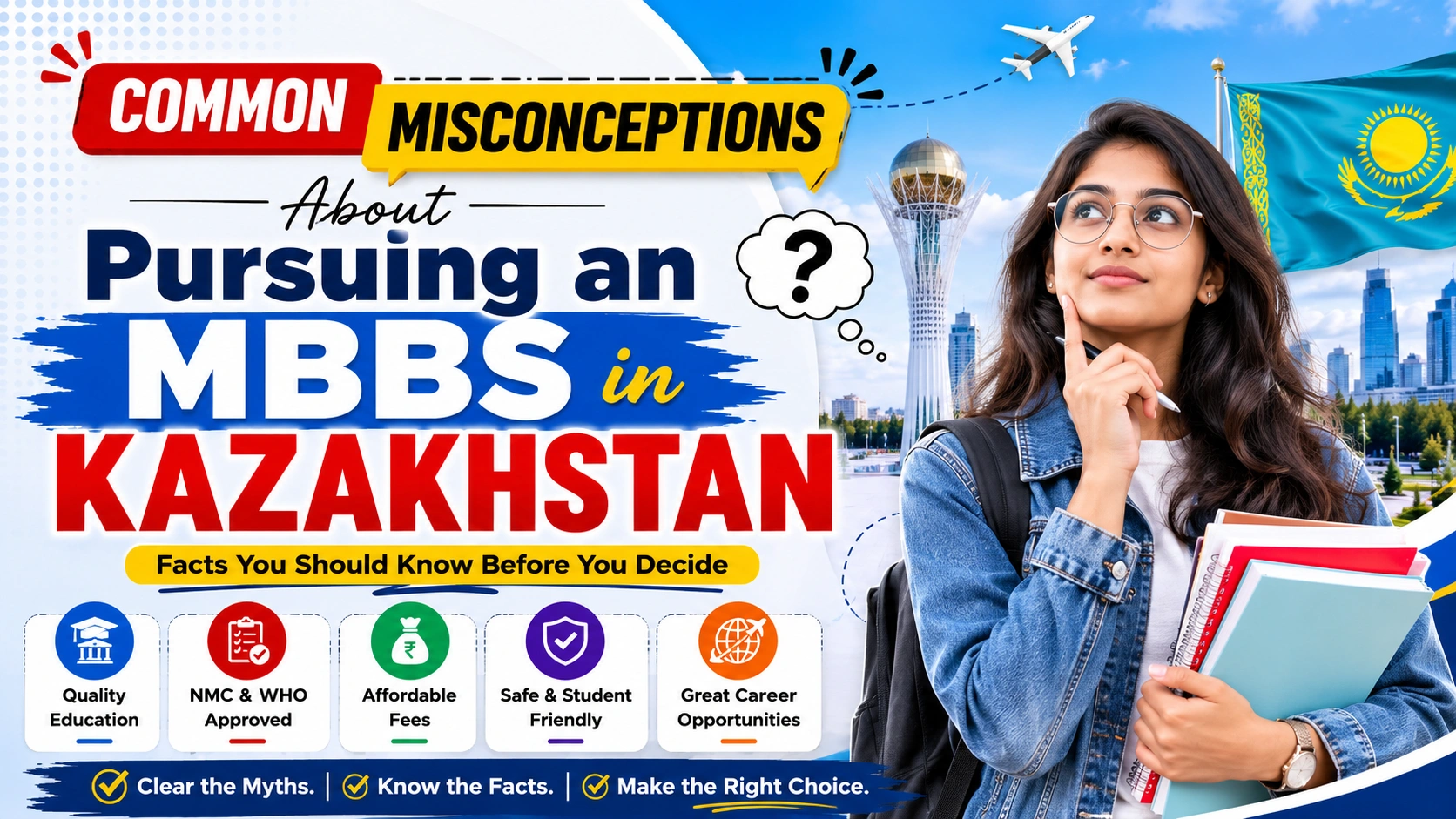
Each year, a sizable portion of Indian students searching for medical school opt to study in one of the many countries in Central Asia, with Kazakhstan emerging as one of the top choices. The most common misconceptions, half-truths, and outdated information regarding MBBS in Kazakhstan often create an unwelcoming environment for new students. Some of the deceptive information creates an unfounded sense of assurance among unprepared students, while some of the unintentional discrimination actively stops students who wouldn't ordinarily have had the opportunity to apply.
In an effort to assist students who intend to pursue their medical degrees in Kazakhstan, we have organized the most common myths and the facts associated with them, citing the NMC, WHO, and WDOMS. Understanding the most common contemporary medical misinformation will help you better determine the reliability of the available medical information.
Factors Contributing to Kazakhstan's Growing Medical Program Popularity
Before explaining the most common myths, it is important to underscore the most common reasons students are choosing to study in Kazakhstan. The ever-increasing competition for a limited number of seats at Indian government-run medical colleges in combination with the ever-increasing costs of Indian private medical colleges have caused many students to consider overseas educational opportunities. Central Asia offers students well priced, internationally accepted, NMC accredited, English-based medical education.
As a result, many student-guidance platforms to pursue Indian students MBBS in Kazakhstan applications have noted an increased interest in their services, particularly those pertaining to the 2026 MBBS in Kazakhstan.
Myth 1: MBBS Degrees from Kazakhstan are Unrecognized in India
- This is one of the worst myths. There are students who think a medical degree from Kazakhstan is worthless in India, and it is not true.
- The Reality: Top medical universities in Kazakhstan are listed in the World Directory of Medical Schools (WDOMS). The WDOMS Directory is a project jointly made by the World Federation for Medical Education (WFME) and the Foundation for the Advancement of International Medical Education and Research (FAIMER). If foreign medical schools are not listed in WDOMS, their degrees cannot be validated in India.
- The National Medical Commission (NMC) is the top-tier authority in medical education in India, and it states that Indian students can pursue MBBS from foreign universities listed in WDOMS, if they clear the Foreign Medical Graduate Exam (FMGE) or the NExT exam (when implemented) in India.
Myth 2: One has to have a Good NEET Score to Study MBBS Abroad
- Many people think that if one doesn't have a good NEET score comparable to Indian government medical colleges, then one cannot pursue MBBS in Kazakhstan. This is a misconception, and it stops a lot of intelligent students from considering this option.
- The Reality: Per the NMC guidelines, the only requirement for Indian students is to pass the NEET (i.e., fulfill the minimum qualifying NEET percentile), not to secure a NEET rank. This is a considerable departure from the domestic application procedure to medical colleges, where the NEET rank is used to determine the college and state quota.
The main admission requirement for MBBS in Kazakhstan is:
- The NMC mandated NEET qualification
- The 12th standard scores of the student in Physics, Chemistry and Biology
- Some basic proficiency in the English language
This is one of the driving factors that students with below average and average NEET scores and a strong determination to pursue a medical career are looking for trusted MBBS in Kazakhstan admission guidance.
Myth 3: Medical Education in Kazakhstan is Substandard
- There is a stereotype that if a student goes to study medicine in another country in Central Asia, they are automatically accepting a substandard education. This is a stereotype of the past and it is incorrect.
- The Reality: Some of the medical universities in Kazakhstan have designed their curricula in consonance with the guidelines of the World Health Organization (WHO) and with the World Federation for Medical Education (WFME) and have incorporated modern teaching methods, advanced labs, and integrated early clinical training. Many universities have also established partnerships with European universities, thereby elevating the teaching standards.
The WHO has been advocating for a long time that countries in the world should modernize their medical education systems to ensure that every health care professional, regardless of where they studied, would meet a sufficient standard of competency. The education ministry of Kazakhstan, in partnership with many countries, has started to fulfill this challenge.
Myth 4: Isn't Kazakhstan a dangerous place for Indian students?
- It is only natural for a parent to be concerned about the safety of their child when they decide to pursue their education abroad. However, most of that concern is based on far-fetched myths rather than reality.
- The Reality: Kazakhstan has one of the largest international student populations in Central Asia. Of all the international students, Indian students are the most numerous. The cities of Almaty, Shymkent, and Karaganda, which are home to a majority of the Medical Universities in Kazakhstan, boast low crime rates and offer international student support services and secure hostels. This makes them some of the safest options for students traveling abroad.
The Indian Embassies in Kazakhstan are in constant contact with the student associations, and the majority of the universities have International Student Coordinators.International Student Coordinators are available to help students adjust to the new culture, assist them with documentation, and support them during emergency situations.
Myth 5: Pursuing an MBBS in Kazakhstan will be a costly affair
- Many students have been led to believe that studying abroad is an option only for the people who belong to the higher economic class. So, they shy away from further exploring the opportunity.
- The Reality: Just the opposite is true! The reasonable cost of Study MBBS in Kazakhstan is one of the key attractions for Indian students. The tuition in Kazakhstan is significantly cheaper than the cost of Private Medical Colleges in India. The cost of living in Kazakhstan is also cheaper when compared to so many other countries, including The USA, the UK, and The Philippines.
When considering the total cost of a 6-Year MBBS (including tuition, hostel, and living expenses), studying in Kazakhstan is cheaper than a private Medical Seat in India that is secured based on donations, and the quality of education will not be impaired.
Myth 6: You Need to Know Russian or Kazakh to Study MBBS There
- This myth discourages students from even investigating options further, believing they will encounter language barriers that will hinder them.
- The Reality: Top medical universities in Kazakhstan offer English MBBS programs catering to international students. While learning a few basic Russian or Kazakh words will help sustain you while you are on rotations, they are not needed for coursework, assessments, or lectures.
Universities usually offer optional language courses during the first year to help students with communicating with local patients during clinical sessions. It is a good-to-have skill, not an entrance barrier.
Myth 7: Returning to India after MBBS in Kazakhstan is Complex
- After pursuing an MBBS overseas, many students think returning to India to practice will involve a tedious process filled with unknowns.
- The Reality: The Network of Medical Councils of India (NMC) has clearly outlined the steps. Post MBBS from a WDOMS-listed institute, Indian students will have to:
- Clear the Foreign Medical Graduate Examination (FMGE), which is soon to be replaced by the NExT exam
- Complete a compulsory internship as per NMC guidelines
- Register with the State Medical Council or NMC to practice in India
- This is the process every Indian student has to complete when returning from any listed foreign medical university and is not specific to or more burdensome for graduates from Kazakhstan.
Myth 8: There are No Opportunities for Practical or Clinical Learning in Kazakhstan
- Some believe that schooling abroad will not provide enough opportunities for practical learning compared to Indian medical schools.
- The Reality: Clinical postings, practical training, and visits to hospitals are part of the curriculum in most universities in Kazakhstan even in the second or third year of study. In fact, in most cases, Indian universities introduce students to clinical exposure much later than their counterparts in Kazakhstan. Teaching hospitals partnering with medical universities in Kazakhstan provide students opportunities to interact with real patients under the supervision of trained faculty, thus, helping students develop skills and competence along with their theoretical knowledge.
Myth 9: Only "Backup" Students Go For Studying MBBS Abroad
Many people think that students who couldn't manage to secure a seat in Indian universities "settle" for studying abroad. This myth does not recognize the fact that students are taking these decisions after careful consideration.
The Reality: A significant fraction of students are now aware of the fact that pursuing MBBS in Kazakhstan is much more economical compared to other places. Students are trading opportunities to get clinical training exposure in English speaking countries in order to gain clinical training and improve their employability at a global level.
Myth 10: All the Medical Universities in Kazakhstan are Equally Good
- Thinking that all Medical Universities are the same in Kazakhstan is going to lead students to have poor choices and selection errors for universities.
- The Reality: Medical universities in Kazakhstan are no different from medical universities in any other country. They all have different levels of faculty experience, infrastructure, and different levels of student support. Make sure you check:
- Universities hosting medical programs are listed in WDOMS
- Recognition and compliance with NMC
- Partnerships with hospitals for clinical training
- Success of alumni in FMGE/NExT
This is the main reason you should work with a qualified admission consultancy to help eliminate poor choices from selection error.
How to Verify Facts Before Choosing a University
Rather than depending on hearsay, myths, or online forums, students and their parents should verify information from trustworthy, official sources.
- The National Medical Commission (NMC). For changes in policies regarding international medical training, screening tests, and registration.
- The World Health Organization (WHO). For international benchmarks in medical and health care training.
- The World Directory of Medical Schools (WDOMS). To check the official recognition status of a particular medical school.
- NEET (National Testing Agency). For information regarding eligibility and scheduling of the NEET exam to study medicine in India or abroad.
Checking information with the sources above focuses your judgment on reason, not fear or assumptions.
Conclusion
The decision to study medicine abroad is a bold, life-changing choice that should be supported with correct, factual information, not casual, circulated myths. With WDOMS listed universities, a NMC-compliant education system, a low-cost fee structure, and the medium of instruction being English, Kazakhstan is a legitimate and viable option for Indian citizens who want to study medicine.
If you still have doubts, you should contact MBBS in Kazakhstan specialized consultants who have the knowledge to help you with your university choice, documents, visa application, NMC requirements, and more, so that you can make the decision based on pertinent information and not on fiction.
Therefore, in regard to the MBBS in Kazakhstan 2026, if you plan ahead and have accurate information, your dream of becoming a doctor via the MBBS in Kazakhstan for Indian Students programs, can actually happen.