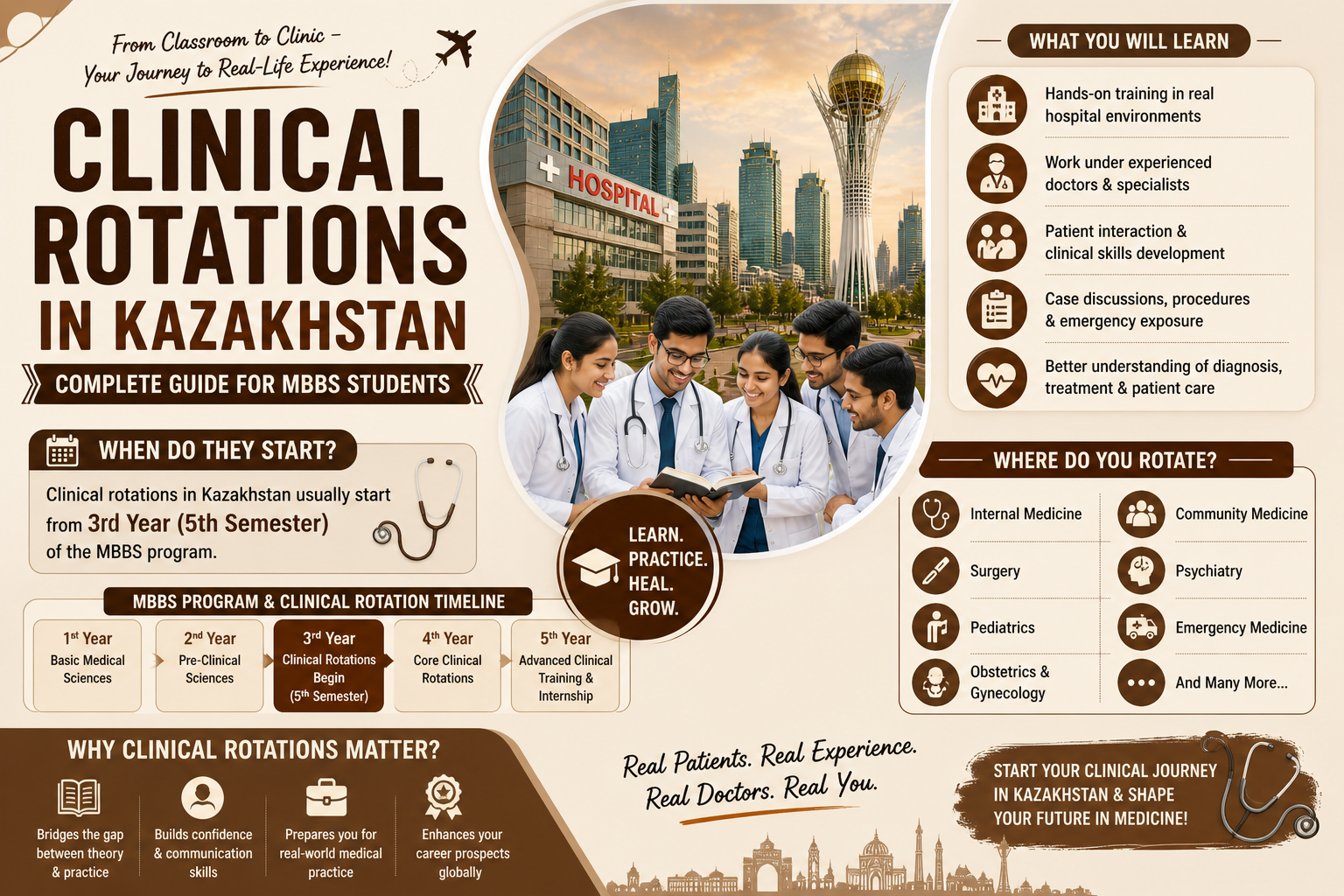
Clinical rounds form one of the vital clinical years of academic rotation for MBBS in Kazakhstan as students start to learn in a real-world environment that requires theoretical knowledge integrated with practical skills and relating it to patient care and hospital training. Knowing when these rotations start and how they progress allows students to be better prepared for their medical career. To read the entire admission cum course guidance, you can visit: MBBS in Kazakhstan
Clinical Rotations Start in Kazakhstan: What You Need to Know
Clinical exposure starts in a phased manner at most medical universities of Kazakhstan:
- Pre-Clinical Years (1st–2nd Year): Anatomy, Physiology, and Biochemistry
- Year 3: Beginning to experience clinical rotations (foundational level)
- 4th–5th Year: Advanced clinical rotations in key departments
- Year 6: Full time intern at a hospital with hands on responsibilities
Thus, students begin clinical rotations from year 3 of MBBS.
How Clinical Rotations Are Structured
Clinical rotations are taught in affiliated government or university hospitals and under the leadership of professional doctors.
Key Departments Covered:
- General Medicine
- General Surgery
- Pediatrics
- Obstetrics & Gynecology
- Psychiatry
- Orthopedics
Students participate in rotation-based clinical experiences for a predetermined time period in each department to receive broad-based knowledge.
Training Methodology
Clinical training in Kazakhstan combines:
- Bedside teaching (direct patient interaction)
- Case discussions and presentations
- Observation of surgeries and procedures
- Basic hands-on practice under supervision
At first students watch senior doctors, then gradually they can take part in some low-level clinical tasks.
Language in Clinical Rotations
Because MBBS is also taught in English, the clinical practice usually consist of:
- Ability to communicate with the patient in local languages (Kazakh/Russian)
- Mundane language training is provided by the universities
Get used to local language medical terms – Since patient interaction is an important aspect, especially in developing countries, students are trained on commonly used medical terminology using the regional language.
Importance of Clinical Rotations
Clinical rotations are a critical aspect of developing a student’s medical career:
- Close the gap between theoretical and practical
- Develop diagnostic and clinical skills
- Improve communication with patients
- Competitive Exams Preparation for FMGE/NExT, USMLE & PLAB
Recognition for Indian Students
Clinical training for Indian students has to comply with the criteria of the NMC. Licensing exams such as FMGE (or an upcoming NExT) require adequate clinical exposure.
Challenges Students May Face
- Limited direct patient interaction initially
- Language barriers in hospitals
- Pressure of self-practice and more exposure to kill
The students are encouraged to stay proactive and get more experience when they can.
Tips to Maximize Clinical Learning
- Start preparing clinical subjects early
- Learn basic Russian/Kazakh medical terms
- Participate actively in ward rounds
- Take notes during case discussions
- Practice clinical skills regularly
Final Thoughts
Clinical training in Kazakhstan starts from Year 3, and builds up to a final-year internship. They are the bedrock of medical education and key to practicing clinical skills in a true-life environment.
With active stress on hospital training and following WHO and WDOMS standards along with clearing NEET, students can gain good clinical skills and be ready with full confidence for global medical careers.