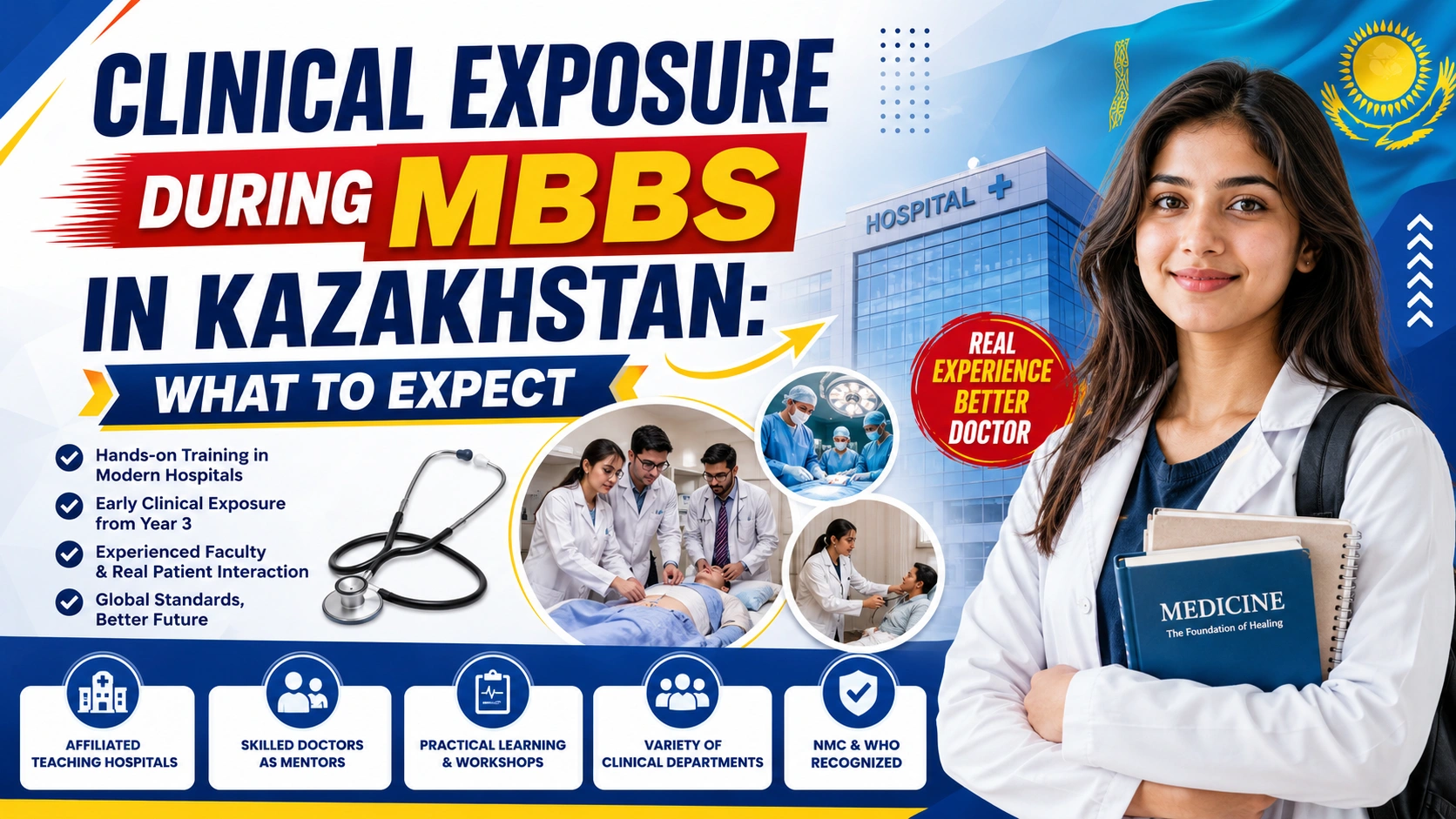
The integration of theory and practice is a vital stage of any educational journey. For Indian students who pursue MBBS in Kazakhstan, clinical exposure is a core component of the course and allows students to become competent doctors and not just successful exam takers.
This blog depicts the nature and the structure of clinical exposure while studying MBBS in Kazakhstan, and the relevance of this exposure for future practice and licensing in India.
Value of Clinical Exposure in Medical Education
Medical science is a practice. Interacting with real patients is the final stage of the educational journey that formal lectures and texts cannot equip students for. Clinical exposure allows students to:
- Apply theory to practice
- Gain confidence to perform basic procedures
- Work in a team
- Develop a host of clinical skills
- Clinicians must be aware that the presentation of a patient may differ from the textbook
Institutions for MBBS in Kazakhstan for Indian students are designed to incorporate clinical exposure during the formative years of the course, while in the subsequent years its intensity is increased to keep pace with the students as they become more advanced and as is the benchmark in medical institutions around the globe.
Structure of Clinical Training During MBBS in Kazakhstan
Early Years: Building the Foundations
During the first two years of the MBBS program, students learn the basic medical sciences, which include Anatomy, Biochemistry, and Physiology. Some universities even incorporate early clinical exposure into their curricula, where students begin early clinical postings and visit hospitals, observe patients, and learn about the healthcare system. Some benefits of early clinical exposure may include the students' ability to:
- Make connections between basic sciences and clinical medicine
- Reduce the anxiety typically experienced during clinical years
- Learn the fundamentals of workplace etiquette and communication
Mid-Course Years: Transition to Clinical Subjects
During the first half of the third year and throughout the fourth year, the focus of the curriculum shifts to clinical subjects such as Pathology, Pharmacology, Microbiology, and core clinical subjects such as Medicine and Surgery. Third year students begin their first structured clinical postings and learn to:
- Conduct ward rounds.
- Take patient histories and perform their first clinical examinations.
- Understand the relationship between diagnostic procedures and clinical medicine.
- Develop case-based clinical reasoning.
Final Years: Intensive Clinical Rotations
During these years students undergo intensive clinical rotations in the following specialties:
- Internal Medicine
- General Surgery
- Obstetrics and Gynecology
- Pediatrics
- Orthopedics
- Psychiatry
- Community Medicine
Students participate in and are taught clinical discussions and case presentations, and are given numerous opportunities to learn and practice skills and clinical procedures. The clinical exposure gained during the course is necessary to prepare the student to take International Licensing Exams.
Hospital Infrastructure and Clinical Facilities
Kazakhstan's medical universities partner with teaching hospitals and clinical centers where a variety of patients and medical cases are available. These clinical facilities usually have:
- Laboratory facilities and diagnostic tools that are up to date
- Systematic inpatient and outpatient departments to assist in the educational process
- Organized departments in major medical and surgical specialties
- The ability to view and participate in clinical procedures
Many of the Kazakhstan medical universities are listed in the World Directory of Medical Schools (WDOMS), maintained by WFME and FAIMER. Thus students have the assurance that the clinical facilities satisfy the infrastructure of clinical training approved by international standards in medical education.
Learning Communication Skills Through Clinical Exposure
Extensive clinical training is required for the development of communication skills and interaction with patients, as there is no way to master this via book learning. Learning takes place during the hospital postings, and students have the opportunity to acquire the skills to:
- Collect a patient history in a clear and kind manner
- Deliver an explanation of medical procedures and conditions in an understanding manner
- Undertake sensitive discussions, for instance, to deliver a diagnosis or explain a treatment plan
- Interact with healthcare staff, including nurses and physicians
For foreign students, this also means engaging in communication with patients who may be multilingual, and this greatly enhances one's ability to communicate and practice medicine in a variety of cultures and countries.
Clinical Skills Labs and Simulation-Based Learning
Many universities that offer MBBS in Kazakhstan for 2026 admissions provide exposure to simulation-based learning in Clinical Skills Labs in addition to exposure in actual hospitals. Students who have access to these resources can:
- Learn and refine technical skills by practicing procedures such as injections and catheter placements on dummies;
- Practice emergency response;
- Build the necessary skills and confidence to perform various clinical procedures;
- Get feedback regarding their performance from instructors in real-time.
Combining simulation-based learning with real-world learning practiced under supervision prepares students before they are expected to perform procedures with little or no supervision.
How Clinical Exposure Prepares Students for Licensing Exams
The extensive clinical exposure that is part of the MBBS program has obvious benefits when students are preparing for the licensing exams to practice medicine in India. The testing system developed by the National Medical Commission (NMC) focuses more on clinical logic and practical application of knowledge than rote learning.
Candidates who have had active clinical postings and practiced clinical skills during their MBBS program are usually able to better answer the scenario and case-based questions in these licensing exams than candidates who have focused learning on theory.
Global Recognition and Its Impact on Clinical Training Standards
The reputation of a university on the global stage affects the quality of clinical exposure offered. The WHO recognition and WDOMS listing generally attest that a university has a well-structured clinical training program and is aligned with International standards of medical education. Such students are likely to be qualified to practice in any part of the world, including India.
It is crucial to consider that an Indian student's eligibility to pursue Medical studies abroad is based upon qualifying in the NEET examination, and part of the investment in international medical education is to pursue studies at a university that offers quality clinical training.
Tips for Getting Good Value from International Clinical Experience
- Be active in the work you do in the hospitals. Ask a lot of questions. Go after the things that give you a chance to practice things under supervision.
- Keep a record of everything you see and everything you do. This record will help you study later in a less chaotic way.
- Focus on making a connection with instructors and senior doctors. The right mentor during this stage of your journey can have a huge positive impact on your education.
- Make the connection between theory and the clinical case you are presented with. This will reinforce classroom theory.
- Be comfortable to practice a clinical skill on multiple occasions before dealing with a real patient.
Main Problems Encountered by Students and Their Solutions
- Problems communicating with patients from different language backgrounds. Many universities provide the services of an interpreter, and some support the learning of a basic local language.
- Not knowing the hospital's way of doing things. To help with this, some hospitals have a "new student" orientation, and some require you to have a senior as a mentor.
- The balance between studying theory and doing practice: This can be done using a variety of time management techniques to get a consistent daily study done.
- Not being comfortable to practice on a real patient. This is significantly reduced by practice in skills labs multiple times before first patient exposure.
Why Clinical Exposure is an Advantage of Coming to Kazakhstan for MBBS Study
The way clinical training is done in the medical universities in Kazakhstan is structured and progressive. This gives Indian students a good reason to come here and get good medical training at an affordable cost. Combine this with the good standing of these universities (WDOMS and WHO affiliated universities) and the students are justified in saying that the clinical training they will receive in these universities will be valuable to them during their course and in their future job in India.
For students thinking about pursuing MBBS in Kazakhstan, it is important to consider the structure of clinical training in advance. This awareness enables more realistic expectations. The future students will be able to prepare better both academically and mentally for this stage of the training.
Conclusion
Practicing medicine is a vital component that nurtures the evolution of an MBBS student into a doctor. Visiting hospitals during the early years, followed by clinical training, helps students integrate the concepts of medicine and related services with actual patient care. Kazakhstan MBBS is an attractive option for Indian students because of the university standards that ensure quality clinical practice. This quality practice when combined with globally accepted standards of university education will enable students to effectively prepare for both university assessment and licensing examinations and practice medicine successfully.