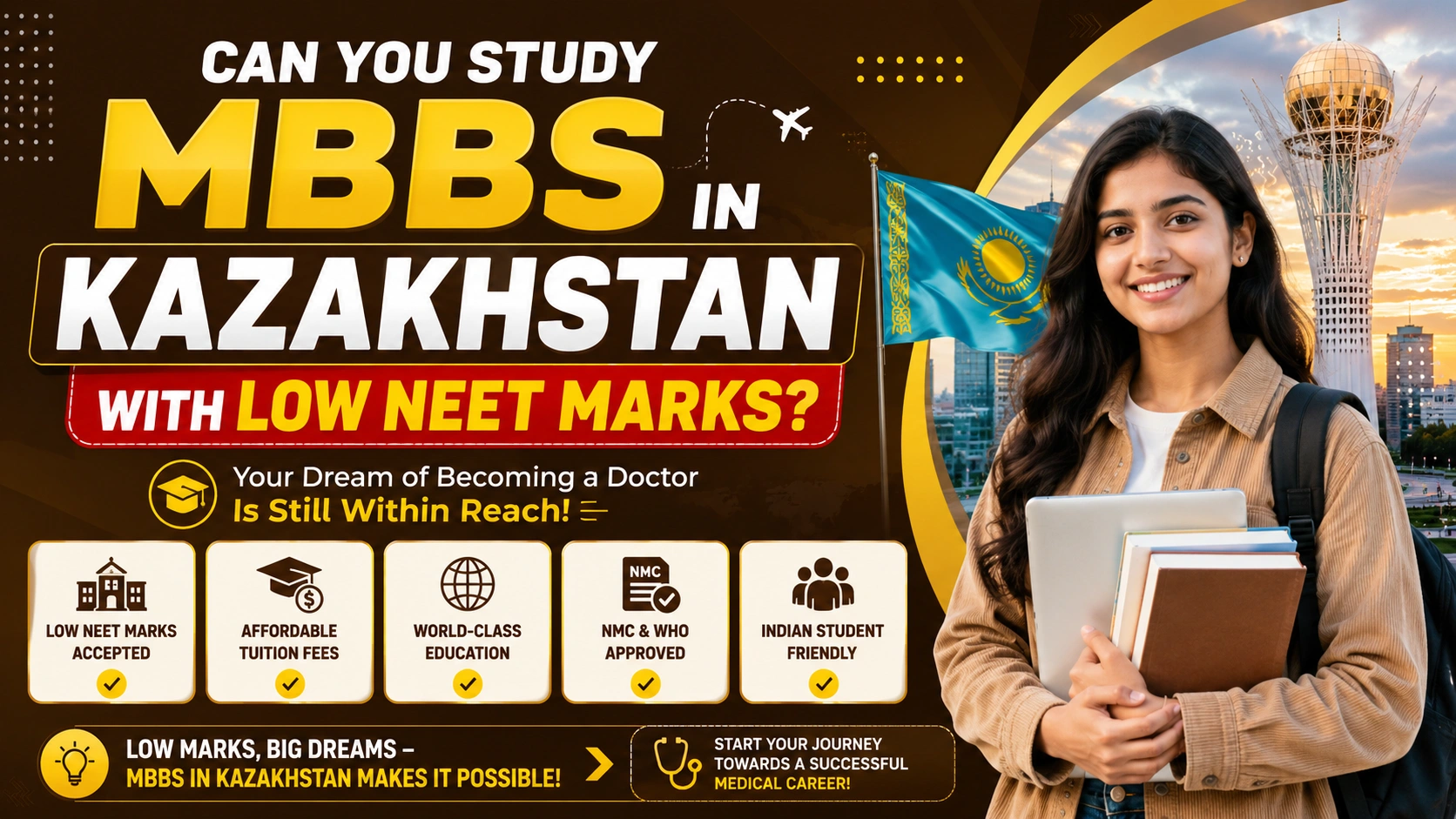
Every year onward from the past several years, millions of aspirational Indian students appear for the National Eligibility cum Entrance Test (NEET) to qualify to become a doctor, but only a handful of them actually get admission to a government medical school in India. If one is among the many students who gets a NEET score just above the qualifying cut-off, and is unsure whether or not the next step in their medical career is to be taken, the good news is: there is still hope. Pursuing an MBBS in Kazakhstan is an excellent option for Indian medical aspirants who have low scores in the NEET exam to attain a medical degree which is recognized and accepted all over the world, and is not as expensive as other countries.
This guide explains the relationship between NEET scores and eligibility for pursuing education in foreign countries, the main reasons why students from India who are NEET-qualified but low scorers are choosing Kazakhstan, as well as other factors one must take into consideration before making a commitment.
What are NEET Qualifying Marks and NEET Rank?
A major contributor to anxiety among students as well as their parents is the misunderstanding of qualifying marks versus admission ranks.
- NEET Rank is the mass admission criteria that offers students a placement in a government or private medical college in India. It is a highly competitive process, considering the approximate 1.1 lakh MBBS seats against NEET's 20 to 24 lakh students in India.
- NEET Qualifying Marks (or Percentile) is simply the mark that the National Testing Agency (NTA) selects each year as the line to determine who has "qualified." For general category students, this is about the 50th percentile. For students of the reserved categories, this is about the 40th percentile.
For Indian students aspiring to study MBBS in Kazakhstan, the second point — qualifying NEET — carries more importance than your all-India rank. Like other foreign medical colleges, the GMCs in Kazakhstan do not have a merit-based selection process for MBBS, as such. Foreign medical colleges do not consider an NEET rank to be a legitimate qualifying rank. As long as your NEET scorecard is marked as "qualified," you have met the requisite eligibility criterion.
So it's fair to ask — is it possible to pursue MBBS in Kazakhstan with poor NEET scores?
The answer is yes, as long as you are above the NEET qualifying score as per the cut-off declared by the NTA for your category, even if your score is way below the scores of those who have obtained government seats in India — you can take admission to MBBS in Kazakhstan. The GMCs in Kazakhstan do not have a NEET score cut-off for Indian students. Admission is primarily based on your academic performance in the 12th class (i.e. marks in English, Physics, Chemistry, and Biology), your passport, and the application form and its supporting documents.
This is why Kazakhstan, along with Russia, Uzbekistan, Kyrgyzstan, Georgia, has specifically attracted students who:
- Qualified NEET but could not secure a seat in an Indian government medical college
- Do not have the financial means to join private medical colleges in India
- Are looking for a globally accredited, English MBBS Course
- Are seeking the affordable total cost of medical education.
Why Kazakhstan Specifically Stands Out
For the above reasons, Kazakhstan has become a highly preferred country for Indians seeking to study medicine. Here are a few reasons why it has gained popularity.
1. Affordable Fee Structure
Compared to private Indian medical colleges, the tuition fee of Kazakh medical universities is lower. The living cost is also lower. It results in middle-class families being able to afford the entire MBBS along with the living and boarding throughout the course.
2. Globally Recognized Universities
Most of the well-established medical universities are listed in the international directories of medical school recognition for practicing or further medical studies.
3. English-Medium Instruction
The universities of Kazakhstan are known to provide MBBS in English for international students.
4. Safe Student-Friendly Environment
Hostels, Indian food, and a support system for foreign students are already present in Kazakhstan which has a large foreign student population.
5. European Style Medical Curriculum
The structure of the curriculum for Kazakh medical universities is along the lines of the European System and entails the combination of theory and practice for all the medical subjects.
When evaluating options for studying MBBS in Kazakhstan, consider university recognition, facilities, clinical training, support for Indian students, and more. You shouldn't just look at the fees.
The Rule That Cannot Be Broken: You Must Pass the NEET
If you wish to practice medicine in India, you must take and pass the NEET. Though the score of the NEET may not be high, it must be done.
As per the notification by the Ministry of Health & Family Welfare in 2018, and reinforced by the National Medical Commission's Foreign Medical Graduate Licentiate (FMGL) Regulations, 2021, any Indian citizen or Overseas Citizen of India intending to pursue an MBBS equivalent degree will have to pass the NEET-UG to get admission to any foreign medical school. Otherwise, you will never be allowed to:
- Sit for the National Exit Test (NExT) which has replaced the FMGE exam.
- Obtain registration with any State Medical Council in India.
- Legally practice medicine in India.
In summary, even if you have a high score in the NEET, the decision for the foreign medical degree is up to you. However, the investment in the degree would be wasted if you have not qualified the exam. To see the latest exam details, visit the official NEET (NTA) site.
NMC Recognition: The Most Important Determining Factor
Make sure the Kazakh university you choose meets the NMC standards for foreign medical education. According to the FMGL Regulations, 2021, the key requirements detail that:
- Students must complete an MBBS program that includes a minimum of 54 months of full-time studies
- Students must complete a 12-month clinical internship at the same institution where they completed their medical studies (split internships are not accepted)
- The program must be entirely offered in the English language
- Students must earn the degree with no more than one transfer
- The university must ensure students are provided with sufficient clinical and practical experience
The National Medical Commission is the highest body that regulates medical education in India, and there is no formal or informal "approved list" of foreign universities. Whenever a foreign graduate applies for the licensing exam, the National Medical Commission assesses the foreign medical degree based on the FMGL Regulations. Therefore, it is your responsibility to confirm the compliance of a medical school through: your education consultant, the medical school's accreditation documents, and medical school education directories. Do not enroll until you verify compliance.
Why WHO and WDOMS Recognition is Important
Two of the most important factors for your Kazakh medical school shortlist are:
- World Health Organization (WHO): While WHO does not "recognize" medical schools like the NMC does with Indian medical schools, the WHO has historically kept a directory of medical schools that serve as a global reference for medical school recognition. WHO has resources for medical education and health workforce on their website.
- World Directory of Medical Schools (WDOMS): This is the new version of the former WHO/AVICENNA directory and is a joint work of the World Federation for Medical Education (WFME) and the Foundation for Advancement of International Medical Education and Research (FAIMER). A medical school's listing in the official WDOMS directory is considered a strong indicator of global recognition, and it is frequently cited when foreign graduates apply for Indian medical licensing examinations, the U.S. examinations (through the ECFMG), and other countries.
Make sure your Kazakh medical school of choice is listed in WDOMS before you apply, and check it against the NMC's FMGL compliance requirements.
Step by Step: What to do Next to Get Admission
Here's what you need to know about studying MBBS in Kazakhstan for the 2026 intake if you've qualified NEET and are not planning to pursue medicine in India based on your score.
- You need to qualify NEET-UG and keep the scorecard with "qualified" status as this will allow you admission to foreign medical schools for three years from the date of qualification. (Make sure you don't lose the scorecard.)
- Based on recognition, medical school infrastructure, and the placement and interactivity track record with Indian students, choose the NMC compliant and WDOMS listed universities in Kazakhstan.
- Check Class 12 eligibility first. For most universities, 50% aggregate in Physics, Chemistry, Biology, and English is mandatory (45% for reserved categories).
- Submit your application with academic documents, passport, NEET scorecard, and passport photographs.
- Receive an admission/invitation letter from the university.
- Apply for a Kazakhstan student visa with the invitation letter and other documents.
- Travel and enroll for a 54-month academic program and subsequent 12-month clinical internship.
- Return to India and qualify for NExT/FMGE for the license to practice medicine in India.
Common Myths About Low NEET Scores and MBBS Abroad
- No NEET means admission to foreign universities, so what does it matter?, It is true, but from a practical standpoint, it's a disaster. If you don't qualify NEET, you will never be able to practice in India, even if you graduate from the best Kazakh university.
- Better NEET means a better university abroad. This is incorrect. Most foreign universities that offer MBBS in Kazakhstan mainly assess your Class 12 marks with the application. NEET rank is not considered.
- All Kazakh universities are equal. This is far from true. Clinical exposure, hostels, recognition status, and other facilities for Indian students are not the same across universities, so research thoroughly.
Final Thoughts
Indian students who have qualified NEET but are below the Indian Government medical seat cutoff still have the option of pursuing their dream of becoming a doctor. Studying MBBS in Kazakhstan offers a solution on a practical, affordable, and internationally accepted pathway. As long as you choose an NMC approved and WDOMS listed university, and hold your NEET qualification, this option remains open.
You should prioritize university research, independently validate the recognition of universities you are interested in, and speak with current students or verified educational consultants. Although your NEET score may not provide you with the best chances, the chances of pursuing your medical career can be improved by choosing the right university and doing the proper compliance checks.