Kazakhstan has remained one of the most popular destinations for Indian students pursuing an overseas Bachelor of Medicine and Bachelor of Surgery (MBBS) degree in recent years. Three core attractions drive this popularity. First, the tuition fees of local medical schools are significantly lower than those of India’s leading private medical colleges. Second, the medical qualifications awarded by recognized universities in Kazakhstan are accepted within major international medical education systems. Third, the country offers a student-friendly environment, affordable living expenses, and a well-established support network for international students. Because of these advantages, Kazakhstan has become a preferred destination for thousands of Indian students who are unable to secure a seat in government medical colleges in India.
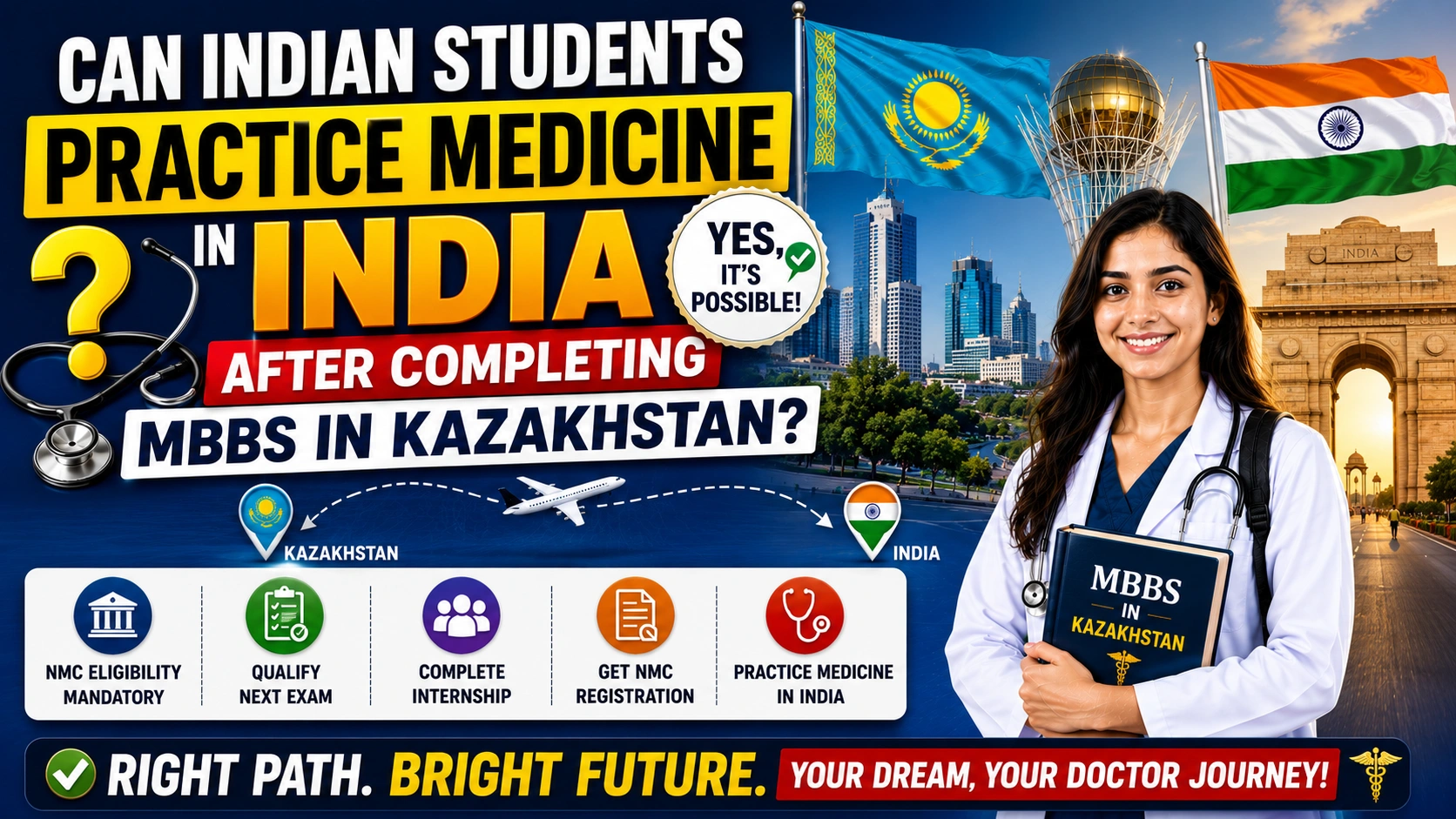
However, one important question continues to concern students and parents alike: Can a student legally practice medicine in India after completing an MBBS degree from Kazakhstan? The answer is yes, but only when students fulfill all academic and regulatory requirements established by the Indian authorities, especially the NMC.
Understanding the Validity of a Kazakhstan MBBS Degree in India
The validity of an MBBS degree earned in Kazakhstan depends on several important factors. Merely obtaining a medical degree from a foreign university is not enough. Students must ensure that the university they choose complies with all required international and Indian regulations.
Important Requirements
- The university should be listed in the WDOMS.
- The institution should follow internationally accepted medical education standards.
- The medical program should meet the requirements prescribed by the NMC.
- Students must complete the entire course duration and clinical training requirements.
- All academic records and documents should remain valid and verifiable.
When these conditions are satisfied, the degree becomes eligible for further professional procedures required for medical practice in India.
Why Choosing the Right University Is Extremely Important
One of the biggest mistakes made by many students is selecting a university solely because of low tuition fees. Cost is important, but it should never be the only factor in the decision-making process. A low-cost university that lacks proper recognition can create serious complications later in a student’s career.
Before Taking Admission, Verify
- Recognition status of the university
- International accreditation credentials
- Clinical training facilities
- Quality of hospital affiliations
- English-medium teaching availability
- Academic reputation
- Student support services
- Compliance with Indian regulations
Proper verification before admission can prevent future legal and professional difficulties.
The Role of NEET in Studying MBBS Abroad
Every Indian student planning to study medicine outside India must understand the importance of the NEET examination. NEET is not merely an entrance examination; it serves as the foundation for future medical career eligibility in India.
Students who wish to pursue MBBS in Kazakhstan must qualify NEET before admission. This requirement has been established by Indian authorities and plays a crucial role in determining future eligibility for professional registration and medical practice in India.
Why NEET Is Important
- Establishes eligibility for overseas medical education
- Supports future professional recognition
- Acts as an important regulatory requirement
- Helps maintain standardization in medical education pathways
Students who ignore this requirement may face significant obstacles during future qualification verification processes.
How the NMC Regulates Foreign Medical Graduates
All Indian students who obtain medical degrees from foreign universities are classified as Foreign Medical Graduates. Their eligibility for medical practice in India is governed by regulations established by the National Medical Commission.
The primary objective of these regulations is to ensure that returning graduates possess medical knowledge, practical skills, and clinical competence equivalent to the standards expected within India’s healthcare system.
Main Goals of the Regulatory Framework
- Maintaining high medical education standards
- Ensuring patient safety
- Verifying clinical competency
- Standardizing qualification assessment
- Strengthening healthcare quality
These regulations are designed to protect both medical professionals and patients.
Importance of Clinical Training During MBBS
Medical education is not limited to classroom learning. Clinical training forms one of the most important components of the MBBS curriculum. Students studying in Kazakhstan must actively participate in practical training and hospital-based learning experiences.
Key Areas of Clinical Development
- Patient examination
- Medical diagnosis
- Clinical decision-making
- Emergency care exposure
- Surgical observation
- Internal medicine training
- Communication with patients
- Ethical medical practice
Strong clinical exposure improves both professional competence and future career opportunities.
Process of Returning to India After MBBS in Kazakhstan
Students planning to build a medical career in India should prepare for the entire professional pathway from the beginning of their studies. Proper planning helps avoid unnecessary delays and complications later.
General Steps
- Complete MBBS from a recognized university
- Maintain all academic records carefully
- Complete required practical training
- Verify educational documents
- Fulfill regulatory requirements
- Complete professional assessment procedures where applicable
- Apply for relevant registration processes
Being organized throughout the course significantly simplifies future procedures.
Common Challenges Faced by Returning Students
Many students focus only on admission and graduation while overlooking challenges that may arise after returning to India. Understanding these issues in advance helps students prepare more effectively.
Common Difficulties
- Delays in document verification
- Administrative processing requirements
- Adaptation to Indian clinical practices
- Understanding regulatory procedures
- Managing professional transition after graduation
- Competitive postgraduate opportunities
Awareness of these challenges allows students to plan strategically.
How to Avoid Future Career Problems
The best way to avoid future complications is to make informed decisions before admission. Proper research and compliance with regulations eliminate many potential risks.
Recommended Actions
- Verify all university credentials
- Confirm international recognition
- Understand NMC requirements
- Review course structure carefully
- Evaluate hospital training opportunities
- Maintain complete academic documentation
- Stay updated with policy changes
Students who follow these steps usually experience a smoother transition into professional practice.
Why Kazakhstan Continues to Attract Indian MBBS Aspirants
Despite growing competition among international study destinations, Kazakhstan continues to maintain its popularity among Indian students. The country offers a balanced combination of affordability, academic quality, and international recognition.
Major Advantages
- Affordable tuition fees
- Reasonable cost of living
- English-medium instruction
- Modern medical infrastructure
- Internationally recognized universities
- Large Indian student community
- Strong clinical exposure
- Simplified admission procedures
These benefits make Kazakhstan an attractive option for students seeking quality medical education abroad.
Career Opportunities After Completing MBBS in Kazakhstan
Graduates are not limited to a single career pathway. Medical education opens multiple professional opportunities depending on individual interests and long-term goals.
Potential Career Options
- Clinical medical practice
- Postgraduate medical studies
- Hospital administration
- Medical research
- Public health services
- Healthcare management
- Academic teaching
- International healthcare careers
A recognized medical degree can provide access to numerous professional pathways.
Common Misconceptions About MBBS in Kazakhstan
Many myths and misunderstandings continue to circulate among students and parents. Accurate information is essential for making informed decisions.
Misconceptions Students Should Avoid
- Lower fees mean lower educational quality
- Every university offers identical recognition
- Clinical training quality is the same everywhere
- Regulations can be ignored until graduation
- University selection should depend only on tuition fees
Careful research helps students avoid costly mistakes.
Tips for Building a Successful Medical Career
Students should begin preparing for their future medical careers from the very first year of study rather than waiting until graduation.
Useful Suggestions
- Focus on academic excellence
- Participate actively in clinical training
- Improve communication skills
- Build strong medical knowledge
- Stay informed about professional regulations
- Maintain organized documentation
- Develop long-term career plans
- Seek mentorship whenever possible
Consistent preparation creates a stronger professional foundation.
Final Conclusion
The MBBS degree obtained from a recognized university in Kazakhstan can support a successful medical career in India, provided students fulfill all applicable regulatory requirements. The key lies in selecting a properly recognized university, qualifying the required eligibility criteria, maintaining academic compliance throughout the course, and understanding the professional pathway well before graduation.
Key Takeaways
- Choose a university recognized by the WDOMS.
- Ensure compliance with NMC regulations.
- Qualify the mandatory NEET examination before admission.
- Verify that the institution follows standards recognized by the WHO.
- Focus on clinical training and academic excellence throughout the program.
- Plan your professional journey early to avoid future complications.
With proper planning, informed university selection, and full regulatory compliance, an MBBS degree from Kazakhstan can become a strong foundation for a rewarding and successful medical career in India.