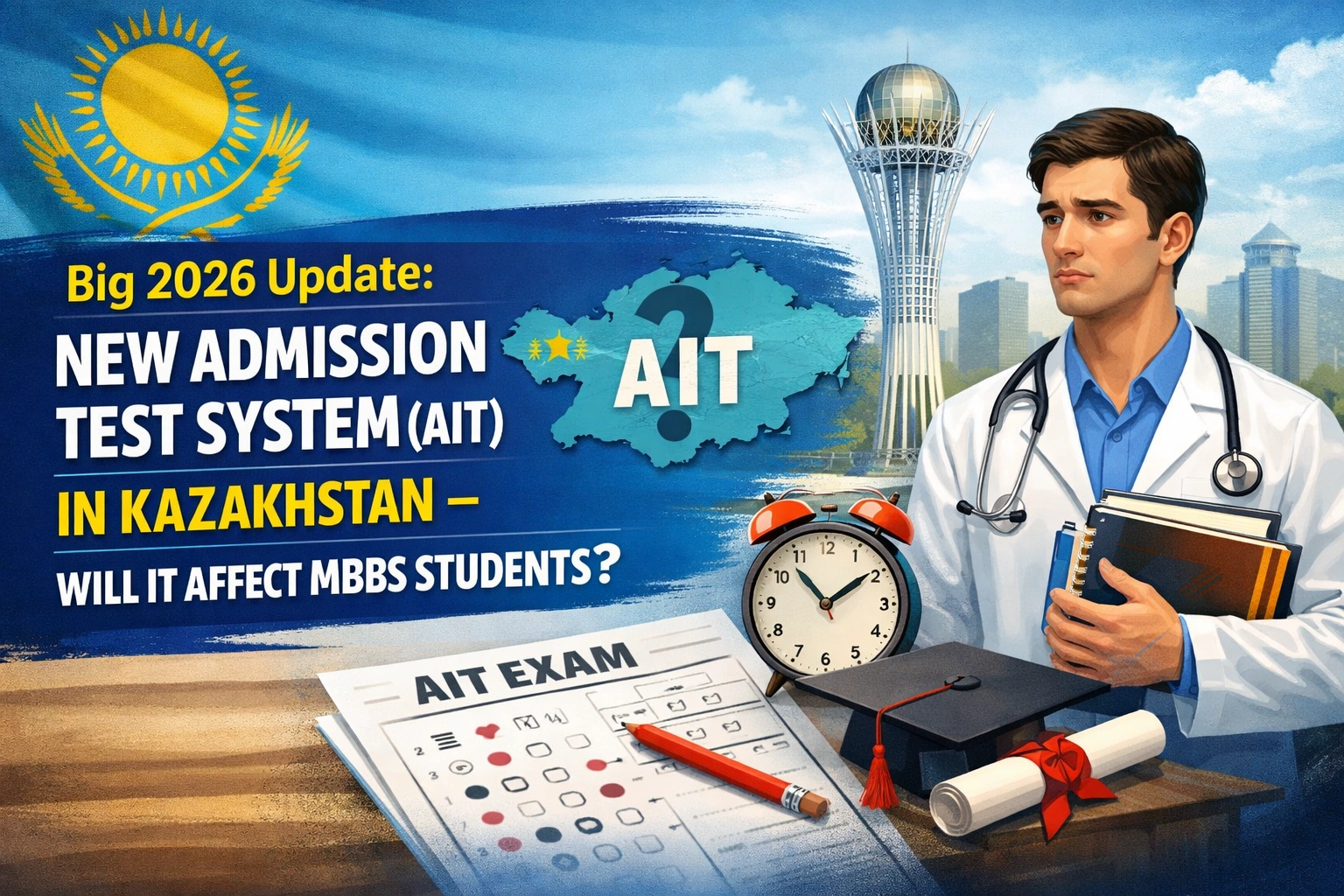
Kazakhstan has introduced a significant reform in its higher education admission system in 2026, known as the Admissions Insight Test (AIT). This development has created confusion among Indian students and parents planning for MBBS in Kazakhstan.
The key concern remains clear:
Will AIT replace the current simple admission process? Will students now need to clear another entrance exam?
This article provides a clear, factual, and structured explanation of AIT and its actual impact on MBBS aspirants.
What is AIT (Admissions Insight Test)?
AIT (Admissions Insight Test) is a newly introduced admission framework developed by Kazakhstan’s education authorities in collaboration with global testing organizations.
Key Objectives of AIT
- Move beyond marks-based evaluation
- Focus on real-world skills and competencies
- Improve transparency in admissions
- Align Kazakhstan with global education standards
What AIT Evaluates
AIT is not a traditional exam. It focuses on:
- Critical thinking
- Analytical ability
- Communication skills
- Problem-solving capability
- Subject understanding
This marks a shift from rote learning to skill-based assessment.
Why Kazakhstan Introduced AIT in 2026
Earlier, Kazakhstan used the UNT (Unified National Testing) system. However, global education trends are evolving, and countries are focusing more on skills rather than memorization.
Reasons for AIT Implementation
- To modernize the admission system
- To ensure fair and skill-based evaluation
- To improve global recognition of degrees
- To prepare students for modern, technology-driven careers
Does AIT Impact MBBS in Kazakhstan?
Short Answer: No (For Indian Students in 2026)
As of now, AIT does not affect MBBS admissions for Indian students.
Current Ground Reality
- AIT is mainly designed for domestic (Kazakh) students
- It is not fully implemented for international medical applicants
- MBBS admission for Indian students continues under the existing system
Current MBBS Admission Process (2026)
For Indian students, the process remains unchanged:
Requirements
- NEET qualification is mandatory
- No additional entrance exam required
- No IELTS or TOEFL required
- Direct admission based on eligibility
This means the admission process is still simple, transparent, and student-friendly.
Why There Is So Much Confusion
The confusion around AIT is due to:
- It being a national-level reform
- Misleading information from some consultants
- Lack of clear public updates for international students
Reality Check
- AIT is being implemented gradually
- It is not currently mandatory for MBBS aspirants from India
Will AIT Become Mandatory in the Future?
This is where parents need to stay informed.
Possible Future Scenario (3–5 Years)
- AIT may be introduced for international students
- It could act as a basic screening tool
- It may replace direct admission gradually
Important Clarification
Even if implemented:
- It will not be as competitive as NEET
- It will focus on basic skills, not high-level competition
- It will remain student-friendly
Will AIT Make MBBS Admission Difficult?
Current Situation: No
Future Possibility: Slightly Structured, Not Difficult
Even if AIT becomes applicable:
- It will test understanding, not ranking
- It will not create extreme competition
- It will be easier than Indian entrance systems
Practical Impact for Indian Students
Current (2026)
- No AIT required
- Admission remains simple
- NEET is the only major requirement
Short-Term (1–2 Years)
- No major changes expected
- Direct admission likely to continue
Long-Term (3–5 Years)
- Possible gradual introduction of AIT
- Improved academic standards
- Better global credibility
Advantages of AIT (If Implemented)
- More transparent admission process
- Better student quality
- Stronger international recognition
- Alignment with global education systems
Possible Challenges
- Additional admission step
- Slight preparation required
- Temporary uncertainty during transition
What Will NOT Change
Regardless of AIT, these fundamentals remain constant:
- NEET qualification will remain mandatory for Indian students
- Universities must comply with NMC guidelines
- Degrees will remain recognized globally
- WDOMS listing will remain essential
This ensures long-term career security.
Strategic Advice for 2026 Students
If you are planning MBBS in Kazakhstan this year:
Focus On
- Qualifying NEET
- Selecting an NMC-compliant university
- Applying early
- Verifying accreditation
Avoid
- Delaying admission due to AIT confusion
- Relying on unverified information
Final Verdict
AIT is a long-term reform aimed at improving Kazakhstan’s education system. However, it has no immediate impact on MBBS admissions for Indian students in 2026.
- Admission remains based on NEET + eligibility
- No additional entrance exam is required
- The process is still straightforward
Conclusion
Kazakhstan is upgrading its education system to meet global standards, and AIT is part of that transformation. However, for Indian students planning MBBS in 2026, nothing changes immediately.
For parents, the key takeaway is simple:
The system is evolving, but the opportunity remains open and accessible.
Instead of worrying about future reforms, focus on making a timely, informed, and well-researched decision today.