When students and parents think about MBBS in Kazakhstan, the most common question is:
👉 “Do you get real hospital training there or do you just learn theory?”
It is a really crucial question because Clinical exposure directly affects the ability to obtain marks in exam FMGE/NExT (under NMC) and become a confident doctor.
So let’s unpack what clinical exposure really looks like in Kazakhstan—not the marketing claims, but real life on the ground in 2026.”
What does “clinical exposure” actually mean?
So, before judging Kazakhstan, please try to understand what clinical exposure is:
- Patient interaction
- Case history taking
- Physical examination
- Assisting in procedures
- Hospital rotations (Medicine, Surgery, etc.)
- Emergency handling
In their absence, MBBS is incomplete — in whichever country.
Clinical Exposure in MBBS in Kazakhstan: How It Works
When Does Actual Hospital Training Begin?
The duration of MBBS in Kazakhstan In most universities:
- Year 1–2 Course: Mainly Theory (Anatomy, Physiology, Biochemistry)
- Year 3: Clinical exposure begins
- Year 4–5: Full hospital rotations
- Internship: Working with actual patients under guidance
They begin learning at the bedside, case discussions and patient interaction from 3rd year.
👉 In fact, this structure is common to many medical systems around the world.
Clinical Skills Students Have Acquired
During clinical years, students typically:
- Attend ward rounds
- Observe and assist doctors
- Take patient histories
- Perform basic examinations
- Participate in case discussions
- Assist in minor procedures
They rotate through departments like:
- Medicine
- Surgery
- Pediatrics
- Gynecology
- Psychiatry
These include rotations through affiliates hospitals which are either government or private giving different types of patients exposure.
Hands-On Training: Reality Check
Universities in Kazakhstan give exposure to hands-on even though it is quite less, for example:
- Assist in patient management
- Help in minor procedures
- Learn diagnostic techniques
Students are trained in:
- Physical examination
- Clinical decision-making
- Patient communication
This gives practical training that instills confidence before graduation.
Simulation Labs: State-of-the-Art but Not a Substitution
Kazakhstan universities use:
- Advanced mannequins
- Simulation labs
- Virtual training systems
Students practice:
- CPR
- Intubation
- Suturing
- Emergency response
These labs are valuable — but they can’t replicate real patient exposure.
Important Truth: The Real Problems Students Face
Now let’s get real — this is what most consultants won’t say.
Compared to India, Late Clinical Exposure
In India:
- Hospital exposure starts at 1st or 2nd year for students
In Kazakhstan:
- How can clinical exposure be given if you barely had a proper 1st and 2nd year?
👉 This can hamper the building of early confidence.
Language Barrier: Biggest Challenge
MBBS also taught in English:
- Patients speak Kazakh or Russian
- Doctors communicate in local language
This leads to problems:
- Difficulty in patient interaction
- Limited participation in case discussions
- Less hands-on experience (if language is weak)
👉 If they don’t learn the local language, students often lack real exposure.
Quality Varies by University
The most important thing is this.
So not all universities are the same:
Good Universities:
- Strong hospital tie-ups
- Active patient flow
- Better clinical training
Average/Low-Quality Universities:
- Limited hospital exposure
- More theory-focused teaching
- Less patient interaction
👉 Only some universities feature strong early exposure, according to reports.
Passive vs Active Learning
In many cases:
- Students watching more than performing
- Less independent clinical responsibility
This means:
👉 You need to step up and get real experience.
Positive Aspect: What Kazakhstan Does Well
There are, however, considerable benefits despite the challenges.
Patient Flow is a Major Problem, Even in Universities
Top universities have:
- High patient inflow
- Diverse medical cases
- Exposure to multiple specialties
It also helps students develop clinical insight.
Structured Clinical Rotations
Students rotate through all major departments in a way that guarantees:
- Broad exposure
- Balanced medical training
- Real-world understanding
Internship Provides Real Experience
During internship:
- Students work like junior doctors
- Handle patients under supervision
- Gain practical confidence
It is an important step for real training.
Global Recognition Matters
Recognition is related with exposures clinical.
There are the following universities to study MBBA in Kazakhstan:
This ensures eligibility for:
- FMGE/NExT (India)
- PLAB (UK)
- USMLE (USA)
Comparison with India: Honest View
Let’s be very clear.
India (Government Colleges):
- Early exposure
- Heavy patient load
- Strong hands-on experience
Kazakhstan:
- Later exposure
- Structured but sometimes limited
- Highly reliant on university + student effort
👉 If you secure a government seat, India offers better clinical exposure.
Ways Students Can Enhance Their Clinical Exposure
Here it is a management strategy for you if you will choose MBBS in Kazakhstan:
Learn Basic Russian/Kazakh
- Improves patient interaction
- Increases participation
Be Active in Hospitals
- Ask questions
- Volunteer for cases
- Build rapport with doctors
(Optional But Smart) Do Internships in India
- A lot of exposure to Indian disease patterns
- Prepare for FMGE/NExT
Start Early Preparation
- Integrate clinical learning with your exam prep
- Focus on practical understanding
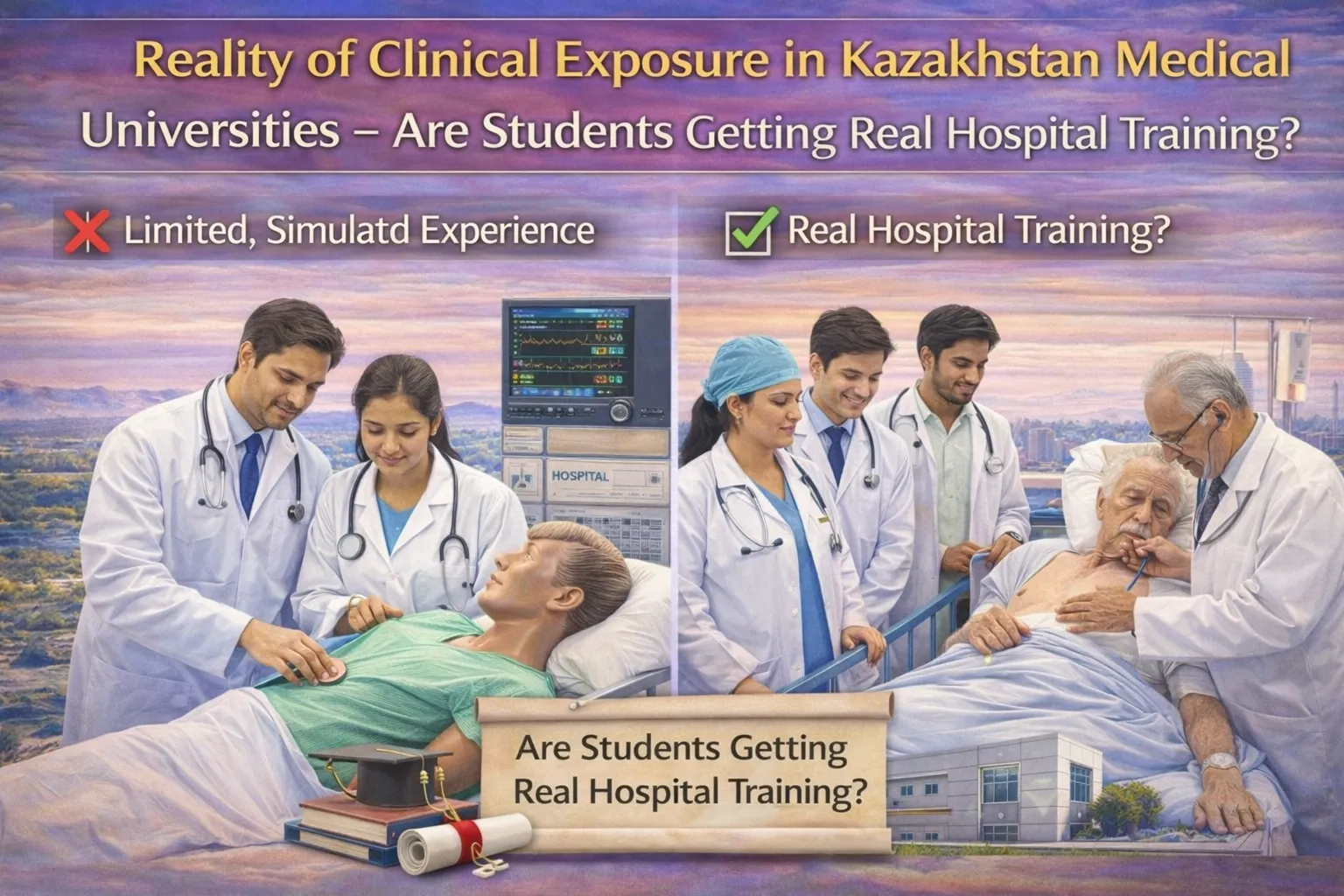
Take away final verdict: Are students getting training for a real?
✔ YES (If Done Right)
- Real hospital exposure exists
- Hands-on training available
- Internship provides strong experience
❌ BUT (Important Conditions)
- Depends on university quality
- Language skills matter a lot
- Student effort is crucial
Conclusion
Clinical exposure in MBBS in Kazakhstan can be best described with the word mixed,No perfection,no fakeness.
You do get:
- Hospital rotations
- Patient interaction
- Practical training
But in terms of exposure, that varies based on:
- Your university
- Your involvement
- Your language skills
Kazakhstan offers a legitimate alternative route that is both affordable and valid due to recognition from NMC, WHO or WDOMS, but this does not mean it is a shortcut.
👉 If you apply yourself with true seriousness, discipline, and scrappiness—you can become a good doctor.
👉 If you rely entirely on classroom teaching — in fact, you may face challenges down the road.