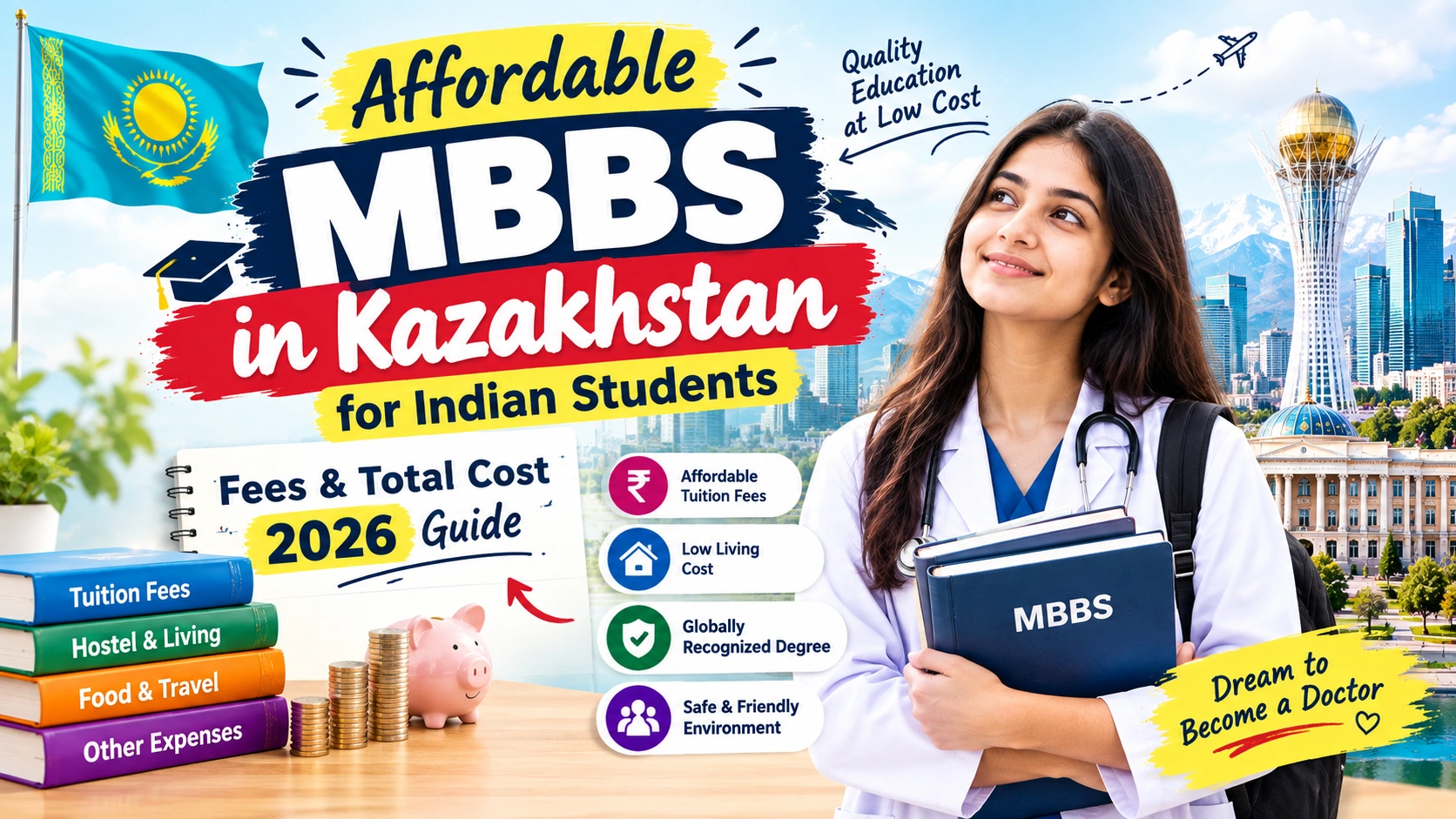
A medical degree abroad starts looking very different once an Indian family sits down with a calculator. Tuition is only one number. Hostel charges, food, insurance, visa renewal, flights, local transport and exchange-rate changes quietly add to the bill. That is exactly why MBBS in Kazakhstan continues to attract Indian students looking beyond expensive private medical colleges in India.Kazakhstan can be relatively affordable, yes. But “cheap MBBS” is an incomplete way to describe it. The real question is whether a university offers the course structure, clinical training, internship arrangement and eligibility conditions an Indian student needs after returning home.For the 2026 intake, students will commonly see advertised tuition in the broad range of roughly ₹3 lakh to ₹6 lakh per academic year, depending on the university and exchange rate. Once hostel and normal living expenses are included, a realistic overall education budget can move towards approximately ₹25–40 lakh or more over the complete program. These are planning ranges, not fixed quotations.That difference matters. A university advertised at ₹3.5 lakh per year isn't automatically a ₹21 lakh medical degree.Students comparing universities can start with the country-specific information available at MBBS in Kazakhstan, but every final admission decision should also be checked against current university documents and Indian regulatory requirements.
Why Is Kazakhstan Considered an Affordable MBBS Destination?
Start with the obvious part: tuition.Many Kazakh medical universities charge international students considerably less than the amounts families may encounter for management or private medical seats in India. There is usually no Indian-style donation attached to a legitimate direct university admission either. That makes the initial numbers attractive.But affordability isn't only about the first-year fee.The country also offers relatively manageable hostel and day-to-day expenses. Depending on the city and lifestyle, a student may spend around ₹12,000–₹25,000 per month on food, transport, mobile services and personal needs, excluding major one-time expenses. Students who cook regularly and use university accommodation can often stay toward the lower side. Frequent eating out changes the calculation. Quickly.Another reason is choice. Universities in cities such as Almaty, Astana, Karaganda and Semey operate in different fee brackets, so students aren't restricted to one price level.Honestly, this is where families should slow down. Choosing the lowest quotation without checking the academic structure can create a much bigger problem later.
MBBS in Kazakhstan Fees for Indian Students in 2026
So, how much money should you actually keep aside?There isn't one nationwide MBBS fee. Each institution sets its own international tuition structure, and payments may be quoted in Kazakhstani tenge, US dollars or another accepted currency. INR figures therefore move with exchange rates.
A broad 2026 planning estimate looks like this:
|
Expense |
Approximate Cost |
|
Tuition fee |
₹3–6 lakh per year |
|
Hostel |
₹50,000–₹1.5 lakh per year |
|
Food & personal expenses |
₹1.5–₹3 lakh per year |
|
Medical insurance |
₹10,000–₹30,000 per year |
|
Visa/registration-related costs |
Variable |
|
Airfare from India |
₹25,000–₹60,000+ per trip |
|
Books, lab coat & study material |
₹15,000–₹40,000 annually |
|
Estimated overall budget |
Around ₹25–40 lakh+ |
Don't treat the last figure as a package price. It is simply a practical budgeting range. University fees can change between intakes, and currency movement alone can alter the INR total noticeably.
University-Wise Approximate Fee Comparison
This part needs a little caution. Universities revise international fee schedules, and agencies sometimes quote different amounts because one quotation includes hostel or service charges while another shows tuition alone.
For initial comparison, students may encounter approximate annual tuition ranges such as:
|
Medical University |
Approx. Annual Tuition Range |
|
Kazakh National Medical University |
₹4.5–6 lakh |
|
Astana Medical University |
₹4–5.5 lakh |
|
Karaganda Medical University |
₹4–5.5 lakh |
|
Semey Medical University |
₹3.5–5 lakh |
|
West Kazakhstan Marat Ospanov Medical University |
₹3.5–5 lakh |
|
South Kazakhstan Medical Academy |
₹3.5–5 lakh |
These are indicative 2026 budgeting ranges rather than official fee quotations. Before paying anything, ask for the latest university-issued fee letter showing tuition, hostel, insurance and other compulsory charges separately.That one document can prevent a lot of confusion.
What Is the Real Total Cost of Studying Medicine in Kazakhstan?
A ₹4 lakh tuition figure looks fantastic on an advertisement. Six years later, that isn't the number your family will have spent.Suppose a student pays roughly ₹4.5 lakh annually toward university tuition. Add accommodation, food, insurance, documentation, travel and everyday expenses, and the yearly family outflow may reach around ₹6–8 lakh in some cases.Over the complete program, that can place the effective cost somewhere around ₹30–40 lakh. A student at a lower-fee institution with controlled living expenses may spend less; a student living independently in a larger city, travelling frequently and dealing with currency appreciation can spend considerably more.There is another issue. Course duration and internship structure must be checked carefully instead of assuming every “6-year program” is identical.The National Medical Commission currently requires foreign medical education to satisfy specific conditions for Indian graduates seeking registration. Its FMGL framework includes at least 54 months of medical education and a 12-month internship at the same foreign institution, along with other requirements such as English-medium instruction and appropriate clinical training.So the cheapest program is useless if its structure creates an eligibility issue later. Simple as that.
Hidden Costs Students Often Forget
Here is where the original budget usually slips.The first overlooked expense is currency fluctuation. If tuition is fixed in local currency or dollars and the rupee weakens, your actual INR payment rises even though the university hasn't increased its fee.Then come smaller expenses: airport pickup, migration registration, document translation, residence formalities, medical tests, winter clothing, SIM cards, local transportation and occasional administrative charges.Flights deserve their own budget. A student returning to India once or twice a year can spend several lakhs on travel across the entire course, particularly when tickets are booked during expensive periods.And winter clothing? Don't underestimate it. Kazakhstan gets seriously cold.Students should ideally keep a contingency reserve of around 10–15% above their calculated total budget. Not because that money will definitely be spent, but because a six-year financial plan based on today's exchange rate is rarely exact.
Eligibility for Indian Students
The academic eligibility itself isn't usually complicated.Indian applicants generally need to have completed Class 12 with Physics, Chemistry, Biology/Biotechnology and English and must satisfy the applicable eligibility requirements for medical education abroad. The exact PCB percentage requirement can depend on the student's category, current regulations and the university concerned.Age conditions also need to comply with the applicable admission rules.And then there is NEET.Indian students planning a foreign undergraduate medical qualification should not treat NEET as optional based on an agent's verbal assurance. Check the applicable requirement and your qualification status directly through the official NEET website and the relevant NMC regulations before taking admission. The official NEET portal currently carries the 2026 information bulletin, results and notices.
Is a High NEET Score Required?
Not necessarily for university admission in Kazakhstan.Many universities don't select Indian applicants through the kind of extremely high NEET cutoffs seen for Indian government MBBS seats. The important distinction is between being eligible under Indian rules and competing for a government medical seat in India.A student may therefore consider MBBS in Kazakhstan even without an Indian government-college-level NEET rank, provided all applicable foreign medical education requirements are satisfied.Don't confuse “NEET qualified” with “automatically eligible for every foreign university and future Indian registration.” They aren't the same thing.
Course Duration and Internship: Check This Before Paying
This deserves more attention than fees.Indian students often hear “six years” and stop asking questions. Instead, ask the university to provide the academic structure in writing. How many months are classroom and clinical education? Where is the internship completed? Is it part of the same institution? Does the student receive hands-on clinical exposure? What is the medium of instruction throughout clinical years?The NMC has specifically cautioned students about foreign institutions that don't meet requirements relating to course duration, medium of instruction, curriculum, clinical training and internship arrangements.For students admitted under the applicable FMGL framework, the NMC requirements include a minimum 12-month internship in the same foreign medical institution and conditions concerning the location and continuity of medical training.Here—well, this is exactly where students need to be careful. A brochure saying “NMC approved” isn't enough. NMC compliance depends on the actual program and your circumstances, not simply a marketing label attached to a university name.
Recognition: NMC, WDOMS and WHO Explained
Recognition gets misunderstood a lot.Students frequently search for an “NMC-approved Kazakhstan university list.” A better approach is to verify whether the individual foreign medical program satisfies current NMC requirements applicable to an Indian citizen who wants registration in India.Then check the institution through the World Directory of Medical Schools (WDOMS). WDOMS is useful for verifying information about medical schools, but directory listing by itself should not be interpreted as automatic approval for medical registration in India.The same caution applies to references to the World Health Organization. Don't select a university merely because an admission brochure displays WHO, WDOMS or NMC logos.Ask practical questions instead.Does the program meet NMC's duration requirement? Is instruction in English? Is clinical training adequate and onsite? Where will the mandatory foreign internship happen? Does the qualification permit registration/licensure in the country awarding it, subject to local requirements?Those questions matter much more than logos.
FMGE/NExT and Returning to India
Cheap tuition doesn't remove the licensing hurdle.An Indian student graduating abroad must satisfy the regulatory pathway applicable at the time they seek registration in India. NMC's FMGL regulations require foreign graduates to clear NExT or another test or tests mandated by the Commission, and the regulatory position should always be checked close to graduation because examination implementation can change over a multi-year medical course.Students beginning in 2026 are planning many years ahead. Nobody should sell them certainty about what a licensing examination will look like at graduation.What can be controlled now is preparation.Choose a university with meaningful clinical exposure. Build concepts from the first year rather than starting Indian licensing-exam preparation in the final semester. Keep your documentation organised. Learn enough local language to communicate with patients during clinical rotations where necessary.That last point is easy to dismiss. It shouldn't be.An English-medium classroom doesn't mean every patient in a hospital speaks English.
Admission Process for the 2026 Intake
Admissions generally become active months before classes begin, although exact application windows differ between institutions.
A typical process looks like this:
- Shortlist suitable medical universities.
- Verify current NMC requirements and university program structure.
- Submit Class 10 and 12 documents, passport and other requested records.
- Provide NEET documents where applicable.
- Receive and verify the university admission or invitation letter.
- Pay only the authorised amount through a traceable payment method.
- Complete visa and migration documentation.
- Arrange insurance, accommodation and travel.
- Report to the university and complete local registration formalities.
Never transfer a large amount just because somebody says seats will disappear “tonight.”
Get the fee breakup first. Read it.
Is MBBS in Kazakhstan Actually Worth the Cost?
For the right student, it can make financial sense.MBBS in Kazakhstan may suit families that cannot justify very high private medical education costs in India but still want a structured overseas medical option within a comparatively controlled budget. Several established medical institutions, international student communities and relatively moderate living costs add to its appeal.There are trade-offs, though.The weather can be difficult initially. Students need to adapt to a different education system and culture. Local-language communication can become necessary in hospitals. Travelling home isn't cheap. Most importantly, returning to India involves regulatory and licensing requirements.So don't choose Kazakhstan simply because the fee looks low.Choose the right university inside Kazakhstan.
Pros and Cons at a Glance
|
Advantages |
Challenges |
|
Relatively affordable tuition |
Licensing pathway after graduation |
|
Lower overall budget than many expensive private options |
Very cold winters |
|
Several established medical universities |
Local language useful during clinical work |
|
International student intake |
Air travel adds to total cost |
|
University hostel options |
Currency fluctuations affect budget |
|
No need for Indian government-college-level NEET rank for many admissions |
Program must satisfy applicable NMC requirements |
How to Choose an Affordable University Without Making a Costly Mistake
Price should be one filter. Not the filter.Compare at least three to five universities and calculate the entire course expense rather than first-year tuition. Ask each institution or authorised representative for the latest written fee structure, hostel cost, program duration, internship details and refund rules.Then verify the academic side independently.For an Indian student, a slightly more expensive university with stronger clinical training and a compliant course structure can be a much better decision than the absolute cheapest option.Also talk to current students. Ask specific questions: Are patients available during clinical rotations? Are classes actually conducted in English? What does food cost monthly? Are hostel charges increased every year? What additional payments were collected after arrival?Real student answers can expose costs that brochures don't mention.
Frequently Asked Questions
What is the average cost of MBBS in Kazakhstan in 2026?
Students can roughly budget around ₹25–40 lakh or more for the complete medical education period, including tuition and major living expenses. The final amount depends on the university, city, exchange rate, hostel choice, travel frequency and personal spending.
How much is the annual tuition fee?
A broad planning range is approximately ₹3–6 lakh per year for many options considered by Indian students. University-issued 2026 fee documents should be checked before admission because fees can change.
Is NEET compulsory for Indian students studying medicine in Kazakhstan?
Indian candidates should verify and comply with the current NEET and NMC eligibility rules applicable to citizens obtaining their primary medical qualification abroad. Don't take admission based solely on an agency statement that NEET isn't required.
Can I complete MBBS in Kazakhstan under ₹25 lakh?
Some advertisements may show totals below ₹25 lakh, usually based on low tuition estimates. Once accommodation, food, travel, insurance, documentation and other expenses are included, maintaining such a low all-inclusive budget can be difficult. Calculate every year before relying on a package figure.
Is a Kazakhstan medical degree valid in India?
A foreign degree doesn't provide automatic permission to practise in India. The graduate must meet the applicable NMC requirements concerning the foreign medical course, internship, eligibility and licensing/registration pathway.
Which is the cheapest medical university in Kazakhstan?
There isn't a permanently “cheapest” university because tuition and exchange rates change. Semey, South Kazakhstan and some other institutions may appear in lower or moderate fee brackets in different admission cycles, but price shouldn't be used without checking the program's regulatory suitability and clinical quality.
Conclusion
The attraction of MBBS in Kazakhstan is understandable. A realistic overall budget of roughly ₹25–40 lakh+ can make it worth investigating for families comparing overseas medical education with considerably more expensive alternatives. But affordability should be calculated across the complete course—not from one attractive first-year tuition figure.Check the university. Check the program. Check the internship. Then calculate food, hostel, flights, insurance, documentation and a 10–15% contingency amount.Most importantly, verify the latest NMC, NEET and university requirements before paying admission fees. If those pieces line up, Kazakhstan can be a practical option for an Indian medical aspirant looking for an affordable route abroad without treating low fees as the only deciding factor.